You walk past the reach-in, glance at the walk-in thermometer, and it’s reading 48 instead of 38. Your stomach drops — that’s thousands of dollars in product and a health-code line you can’t cross. Take a breath: a climbing walk-in isn’t always a dead compressor, and a few quick checks will tell you whether you can fix it in the next five minutes or need a tech on the way now.
Work through the checklist below in order. It moves from the fastest, most common causes to the ones that mean your unit needs professional walk-in cooler repair. As you go, keep an eye on the product temperature, not just the air temperature — the air warms first, but food safety is measured in the food.
First, protect the product
Before you troubleshoot anything, buy yourself time. Keep the door shut except when you absolutely have to open it — every open door dumps cold air and pulls warm, humid kitchen air in. Move the most perishable, highest-value items (raw proteins, dairy, prepped items) toward the back near the evaporator where it’s coldest, or shift them to a working reach-in or freezer if you have the space. Note the time you first saw the temperature climb; the FDA “danger zone” clock (above 41°F) matters if you later have to decide what to keep.
The walk-in cooler troubleshooting checklist
- Check the thermostat setpoint. It sounds obvious, but a bumped dial or a setpoint someone “adjusted” overnight is the single most common false alarm. Confirm it’s set where it should be (typically 35–38°F for a cooler) and that the display isn’t in a defrost or off mode. If the setpoint is correct and the box still won’t pull down, move on.
- Confirm the compressor and condenser are actually running. Go to the condensing unit — often on the roof, out back, or on top of the box. You should hear the compressor humming and feel the condenser fan pushing air. If the fan is spinning but the box isn’t cooling, or if nothing is running at all, that’s a red flag. A dead-silent condensing unit usually means an electrical fault, a tripped breaker, a failed contactor, or a compressor that’s overheated and shut itself off on a safety.
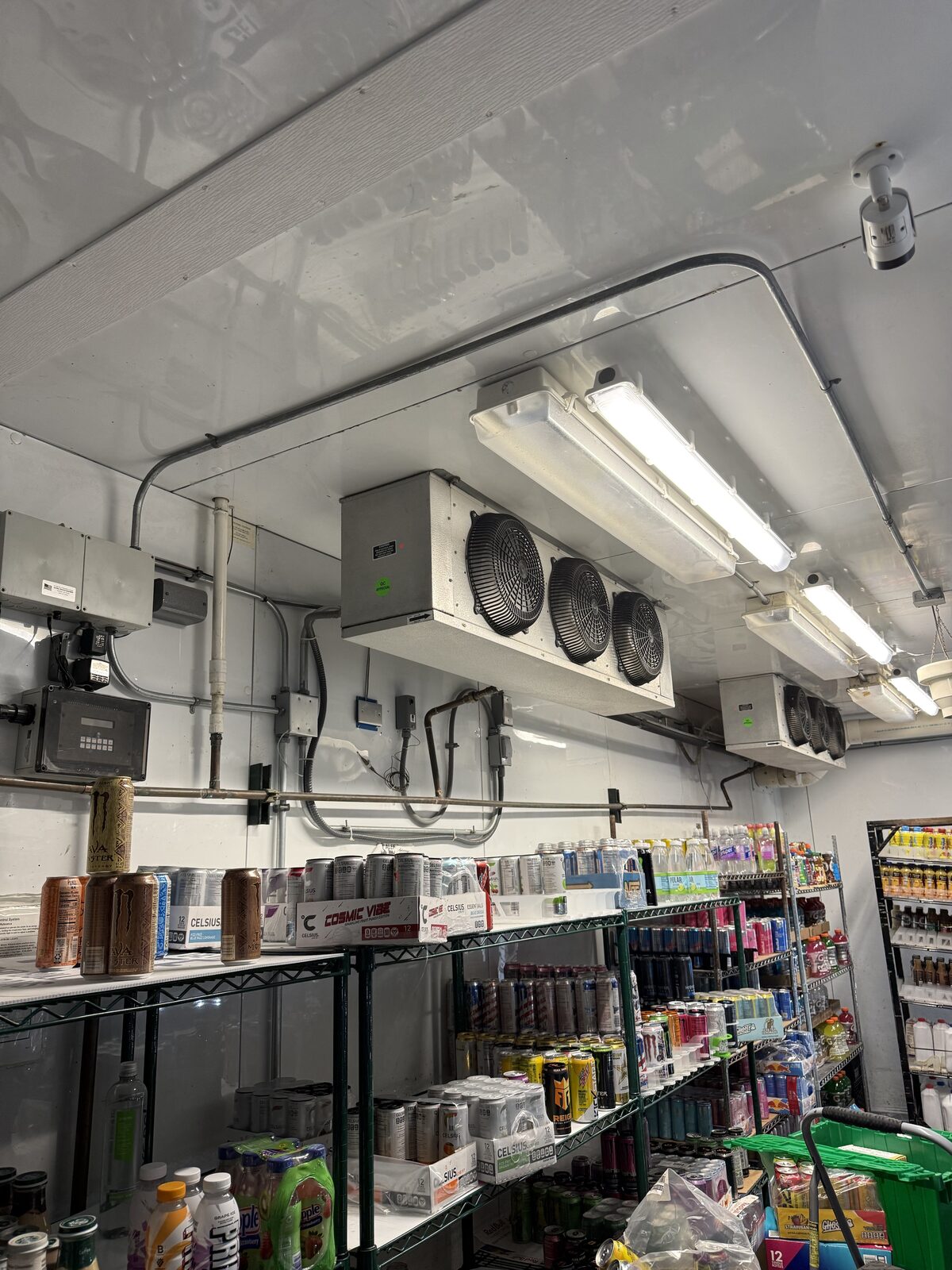
- Clear blocked airflow at both coils. Refrigeration is all about moving heat, and heat moves on airflow. At the condenser (outside/top unit), look for a coil packed with grease, dust, lint, or cottonwood — a dirty condenser can’t reject heat, so the box slowly loses its ability to cool, especially on hot days. At the evaporator (the blower unit inside the box), make sure nothing is stacked against it. Boxes, sheet pans, or shelving jammed under the evaporator choke the cold-air throw and leave dead warm spots.
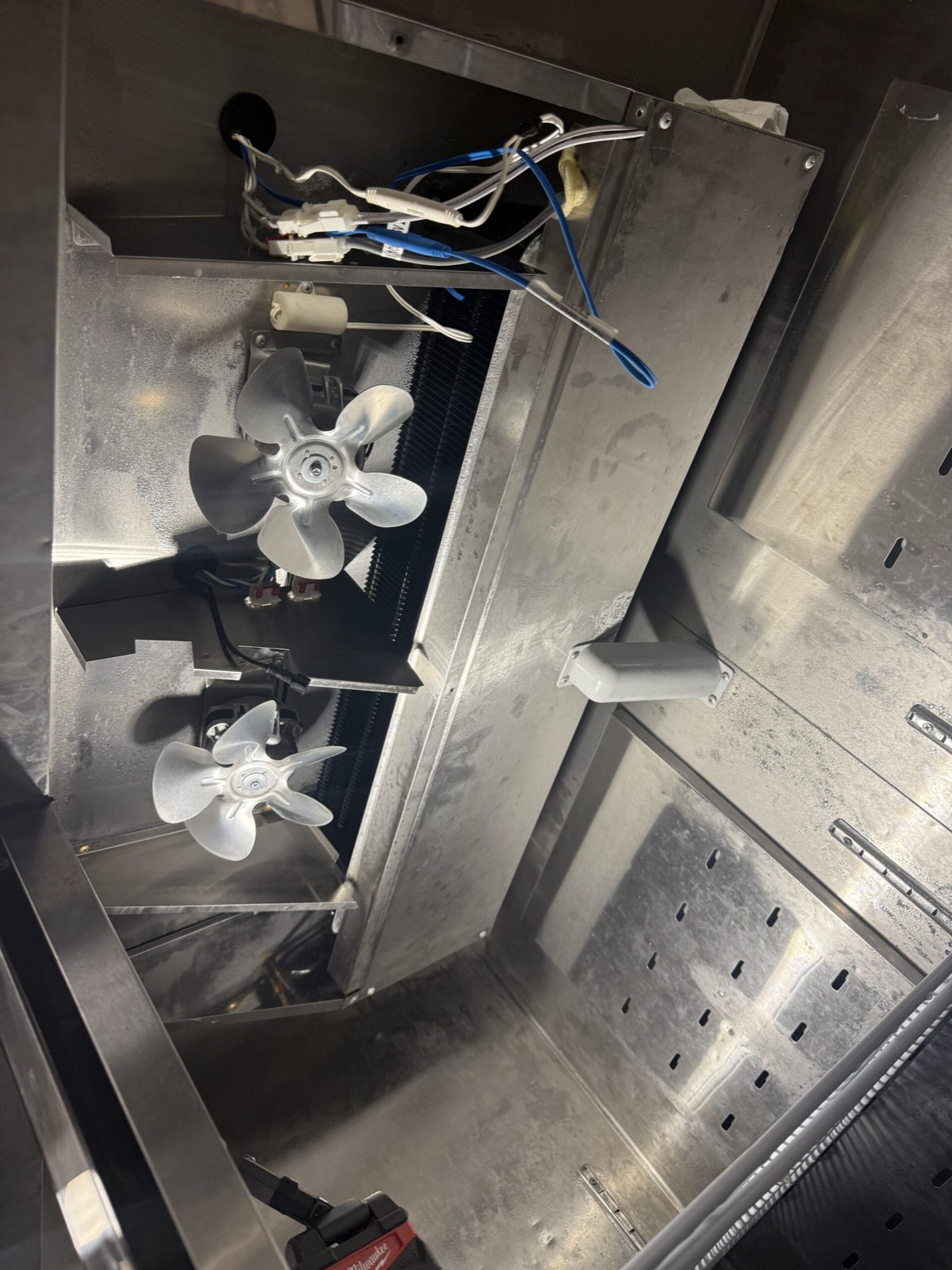
- Look for iced-over coils that need defrost. Open the box and look at the evaporator. A light frost is normal; a solid block of ice over the coil is not. When the evaporator ices up, air can’t pass through it and the box warms even though the compressor is running hard. This points to a defrost problem — a failed defrost timer, heater, or termination sensor — or a low refrigerant charge. You can manually shut the unit down to let the ice melt fully (put a fan on it and towels down for the meltwater), but if it re-ices within a day, the underlying fault is still there.
- Check the door seals, gaskets, and that the door actually closes. Walk the door. Is the sweep gasket torn, flattened, or hanging? Do the magnetic gaskets seal all the way around, or can you see daylight at a corner? Is the closer weak so the door drifts open, or is a stray milk crate propping it? A bad seal or a door left cracked lets warm, moist air pour in nonstop — which both raises the temperature and feeds the ice-up in step 4. This is a cheap fix that owners overlook constantly.
- Listen for short-cycling. Stand by the condensing unit for a few minutes. A healthy unit runs a steady cycle, then rests. If the compressor kicks on for only a few seconds, snaps off, and restarts again and again, that’s short-cycling — and it will never pull the box down while it’s happening. Short-cycling points to a refrigerant issue, a failing control, a dirty condenser, or an overloaded compressor. It also destroys compressors fast, so don’t let it run for days.
What each result means — and when it’s “call now”
If steps 1, 3, and 5 were the problem — a bumped setpoint, a dirty condenser you can brush out, or a blocked evaporator or propped door — you may recover on your own and watch the temperature fall back into range over the next hour. Great. Keep an eye on it through the next full day.
Call for professional help now if any of these are true: the condensing unit is silent or the compressor won’t start; the coil re-ices after you’ve defrosted it; you hear steady short-cycling; or the box simply won’t return to temperature within an hour or two of correcting the obvious stuff. Those are refrigerant, electrical, or component failures that need gauges, tools, and a licensed tech — and every hour you wait is inventory at risk. The same goes if the temperature keeps swinging up and down rather than holding steady, which is its own diagnostic path we cover under temperature fluctuation.
When to call a pro
You know your kitchen; we know the machine. The checklist above is meant to catch the fast wins and tell you when you’ve hit the limit of what’s safe to do yourself. Anything involving refrigerant, the compressor, electrical controls, or repeated failures belongs with a commercial tech — poking at a sealed system or live electrical without training is how a bad day turns into a dangerous one. If your box still isn’t holding temperature, our team handles emergency refrigeration not cooling calls and general cooler repair across the region, usually same-day, so you’re not sitting on spoiling product.
FAQ
How long can a walk-in cooler stay safe once it stops cooling?
A well-sealed, full walk-in with the door kept shut can hold safe temperatures for a couple of hours, but it’s a sliding scale — a lightly loaded box or one that’s been opened warms much faster. Track when the food (not just the air) passes 41°F. Once product sits above that for four hours total, health guidelines say to discard it, so getting a tech moving early is what saves the inventory.
Why is my walk-in freezing food but the temperature still reads warm?
That’s usually an iced-over or malfunctioning evaporator, or a sensor placed in a cold-air stream. Ice on the coil blocks airflow so the box reads warm while the coldest spot near the blower over-freezes product. It can also be a defrost fault. If a manual defrost doesn’t fix it for good, it needs a diagnostic.
Can a dirty condenser really stop a walk-in from cooling?
Yes. The condenser rejects the heat your cooler pulls out of the box. When it’s caked with grease and dust, it can’t shed that heat, so the compressor runs longer and longer and eventually can’t keep up — especially on hot days. Regular condenser cleaning is one of the cheapest ways to prevent a mid-service breakdown.
Still not cooling? Don’t risk your inventory. Call 508-521-9477 for same-day commercial refrigeration repair across New Bedford, Fall River, and Southeastern Mass & Rhode Island — we diagnose fast and get you back up.
You walk past the reach-in, glance at the walk-in thermometer, and it’s reading 48 instead of 38. Your stomach drops — that’s thousands of dollars in product and a health-code line you can’t cross. Take a breath: a climbing walk-in isn’t always a dead compressor, and a few quick checks will tell you whether you can fix it in the next five minutes or need a tech on the way now.
Work through the checklist below in order. It moves from the fastest, most common causes to the ones that mean your unit needs professional walk-in cooler repair. As you go, keep an eye on the product temperature, not just the air temperature — the air warms first, but food safety is measured in the food.
First, protect the product
Before you troubleshoot anything, buy yourself time. Keep the door shut except when you absolutely have to open it — every open door dumps cold air and pulls warm, humid kitchen air in. Move the most perishable, highest-value items (raw proteins, dairy, prepped items) toward the back near the evaporator where it’s coldest, or shift them to a working reach-in or freezer if you have the space. Note the time you first saw the temperature climb; the FDA “danger zone” clock (above 41°F) matters if you later have to decide what to keep.
The walk-in cooler troubleshooting checklist
- Check the thermostat setpoint. It sounds obvious, but a bumped dial or a setpoint someone “adjusted” overnight is the single most common false alarm. Confirm it’s set where it should be (typically 35–38°F for a cooler) and that the display isn’t in a defrost or off mode. If the setpoint is correct and the box still won’t pull down, move on.
- Confirm the compressor and condenser are actually running. Go to the condensing unit — often on the roof, out back, or on top of the box. You should hear the compressor humming and feel the condenser fan pushing air. If the fan is spinning but the box isn’t cooling, or if nothing is running at all, that’s a red flag. A dead-silent condensing unit usually means an electrical fault, a tripped breaker, a failed contactor, or a compressor that’s overheated and shut itself off on a safety.
- Clear blocked airflow at both coils. Refrigeration is all about moving heat, and heat moves on airflow. At the condenser (outside/top unit), look for a coil packed with grease, dust, lint, or cottonwood — a dirty condenser can’t reject heat, so the box slowly loses its ability to cool, especially on hot days. At the evaporator (the blower unit inside the box), make sure nothing is stacked against it. Boxes, sheet pans, or shelving jammed under the evaporator choke the cold-air throw and leave dead warm spots.
- Look for iced-over coils that need defrost. Open the box and look at the evaporator. A light frost is normal; a solid block of ice over the coil is not. When the evaporator ices up, air can’t pass through it and the box warms even though the compressor is running hard. This points to a defrost problem — a failed defrost timer, heater, or termination sensor — or a low refrigerant charge. You can manually shut the unit down to let the ice melt fully (put a fan on it and towels down for the meltwater), but if it re-ices within a day, the underlying fault is still there.
- Check the door seals, gaskets, and that the door actually closes. Walk the door. Is the sweep gasket torn, flattened, or hanging? Do the magnetic gaskets seal all the way around, or can you see daylight at a corner? Is the closer weak so the door drifts open, or is a stray milk crate propping it? A bad seal or a door left cracked lets warm, moist air pour in nonstop — which both raises the temperature and feeds the ice-up in step 4. This is a cheap fix that owners overlook constantly.
- Listen for short-cycling. Stand by the condensing unit for a few minutes. A healthy unit runs a steady cycle, then rests. If the compressor kicks on for only a few seconds, snaps off, and restarts again and again, that’s short-cycling — and it will never pull the box down while it’s happening. Short-cycling points to a refrigerant issue, a failing control, a dirty condenser, or an overloaded compressor. It also destroys compressors fast, so don’t let it run for days.
What each result means — and when it’s “call now”
If steps 1, 3, and 5 were the problem — a bumped setpoint, a dirty condenser you can brush out, or a blocked evaporator or propped door — you may recover on your own and watch the temperature fall back into range over the next hour. Great. Keep an eye on it through the next full day.
Call for professional help now if any of these are true: the condensing unit is silent or the compressor won’t start; the coil re-ices after you’ve defrosted it; you hear steady short-cycling; or the box simply won’t return to temperature within an hour or two of correcting the obvious stuff. Those are refrigerant, electrical, or component failures that need gauges, tools, and a licensed tech — and every hour you wait is inventory at risk. The same goes if the temperature keeps swinging up and down rather than holding steady, which is its own diagnostic path we cover under temperature fluctuation.
When to call a pro
You know your kitchen; we know the machine. The checklist above is meant to catch the fast wins and tell you when you’ve hit the limit of what’s safe to do yourself. Anything involving refrigerant, the compressor, electrical controls, or repeated failures belongs with a commercial tech — poking at a sealed system or live electrical without training is how a bad day turns into a dangerous one. If your box still isn’t holding temperature, our team handles emergency refrigeration not cooling calls and general cooler repair across the region, usually same-day, so you’re not sitting on spoiling product.
FAQ
How long can a walk-in cooler stay safe once it stops cooling?
A well-sealed, full walk-in with the door kept shut can hold safe temperatures for a couple of hours, but it’s a sliding scale — a lightly loaded box or one that’s been opened warms much faster. Track when the food (not just the air) passes 41°F. Once product sits above that for four hours total, health guidelines say to discard it, so getting a tech moving early is what saves the inventory.
Why is my walk-in freezing food but the temperature still reads warm?
That’s usually an iced-over or malfunctioning evaporator, or a sensor placed in a cold-air stream. Ice on the coil blocks airflow so the box reads warm while the coldest spot near the blower over-freezes product. It can also be a defrost fault. If a manual defrost doesn’t fix it for good, it needs a diagnostic.
Can a dirty condenser really stop a walk-in from cooling?
Yes. The condenser rejects the heat your cooler pulls out of the box. When it’s caked with grease and dust, it can’t shed that heat, so the compressor runs longer and longer and eventually can’t keep up — especially on hot days. Regular condenser cleaning is one of the cheapest ways to prevent a mid-service breakdown.
Still not cooling? Don’t risk your inventory. Call 508-521-9477 for same-day commercial refrigeration repair across New Bedford, Fall River, and Southeastern Mass & Rhode Island — we diagnose fast and get you back up.