Years in the field, one region, one kind of equipment. Armus Refrigeration works out of 88 Mill Street in New Bedford, Massachusetts, and the cold side of the kitchen is the only thing we do: walk-in coolers, walk-in freezers, ice machines, reach-ins, prep tables, glass-door merchandisers, display cases, and the condensing units that feed all of it. We repair that equipment and we maintain it. We do not sell it, and we do not work on household refrigerators.
One number reaches us day or night: 508-521-9477. Nights, weekends, and holidays included.
Years on the same equipment, in the same region
Working one territory on one class of equipment buys something no manual gives you: pattern recognition. When a True T-49 reach-in starts cycling every few minutes around year eight, we check the start relay and the overload before anyone says the word compressor. When a Manitowoc ID-series machine drops to thin, cloudy ice, we already know South Coast and Rhode Island water hardness puts those units on a six-month descaling schedule, not the twelve-month interval printed in the book.
That experience is also why we stayed a service company instead of becoming a dealer. The moment a sales commission rides on a diagnosis, every recommendation to replace becomes suspect. Same reasoning behind quoting on site instead of publishing a price list. We have watched the same ice machine symptom turn out to be a cheap bin probe on one call and a full gearbox on the next. Diagnose first, quote second, repair third, and you approve the number before a wrench turns.
What EPA Section 608 certification actually means
Section 608 of the federal Clean Air Act makes it illegal for anyone to open a refrigerant circuit without certification. It is not a trade association badge, it is federal law, and it comes in four categories:
- Type I covers small appliances holding under five pounds of refrigerant.
- Type II covers high-pressure and very-high-pressure systems. That is most commercial refrigeration: walk-ins, reach-ins, ice machines, remote condensing units.
- Type III covers low-pressure systems, mainly large chillers.
- Universal covers all three.
For the work in your kitchen, Type II is the legal minimum. Our crew holds Universal, because we do not want a tech standing in front of a unit discovering he cannot legally recover the charge. Section 608 certification does not expire, so the right question for any contractor is which category the person on your job holds, not when their card was renewed. If nobody at the company can answer that, you have your answer.
The rule governs handling as much as repair. Refrigerant never gets vented. It goes into approved recovery cylinders and then to a certified reclaimer, and you get signed documentation for your file.
Licensed in Massachusetts and Rhode Island, insured on every job
Massachusetts licenses refrigeration work through the Board of State Examiners of Refrigeration Technicians, in journeyman and master tiers. Rhode Island runs its own structure through the Department of Labor and Training Mechanical Trades Board, where commercial work requires a master refrigeration license. We hold the licensing required in both states, our license numbers appear on every quote and invoice, and they are on the truck. If a refrigeration company cannot produce a license number when you ask, that is a red flag worth acting on.
We carry $1 million in general liability coverage plus workers compensation on every employee, and we send a Certificate of Insurance on request, usually the same day. On site we run lockout/tagout under OSHA 1910.147 on every job: power disconnected, locked out at the breaker, tagged with our information and the date, verified dead with a meter before anyone touches a terminal. Unglamorous, and it is why nobody on this crew has been hurt on a service call.
The equipment classes and brands we service
Our work splits into a handful of equipment classes: walk-in coolers and freezers, both self-contained and remote-condensing, including panel, door, gasket, and defrost work; reach-ins, undercounters, prep tables, and glass-door merchandisers; keg coolers and back-bar equipment; refrigerated display cases and blast chillers; and cube, flake, and nugget ice machines with their bins and dispensers.
The nameplates we see most are True, Beverage-Air, Traulsen, Continental, Norlake, Kolpak, Master-Bilt, and Bally on the cabinet side, and Manitowoc, Hoshizaki, Scotsman, and Ice-O-Matic on the ice side. We also keep a lot of legacy Bohn and Heatcraft condensing units from the 1980s and 1990s running in mill-conversion basements in Fall River and on Federal Hill in Providence. On refrigerants we handle R-134A, R-404A, R-448A, R-449A, and the naturals now appearing in new self-contained equipment, including R-290 propane, which needs different leak detection and different handling.
Start with commercial refrigeration repair if you are not sure which category your unit falls into, or go straight to walk-in cooler repair, walk-in freezer repair, ice machine repair, reach-in cooler repair, or commercial freezer repair.
Our service area, and the logic behind it
The core is the South Coast, because that is where we are. New Bedford, Fairhaven, Acushnet, Dartmouth, Mattapoisett, Marion, Wareham, Fall River, and Somerset are typically a 30-minute response. From there the map follows the highways. Route 195 west puts Providence, East Providence, Pawtucket, Cranston, Warwick, and Newport inside a comfortable run. Route 24 and Route 140 north cover Taunton, Raynham, Brockton, Quincy, and into Boston. Across the bridge takes us up the Cape through Bourne, Sandwich, Falmouth, and Hyannis.
We work Worcester, Framingham, and Cambridge as well, and we will tell you honestly on the phone what the drive time looks like rather than quoting an arrival window we cannot hold. Coverage detail sits on the service areas page, with town-level pages for New Bedford, Fall River, and Rhode Island.
How emergency dispatch actually works
A walk-in that quits at 2 AM is not a ticket. It is thousands of dollars of inventory getting warm before a Saturday service. Here is what happens when you call.
- The line is answered around the clock. You describe the unit, the symptom, and how long it has been down.
- We triage on the phone first. If it is a tripped breaker, a defrost timer that needs a reset, or a drain a manager can clear with a wet vac, we walk you through it and there is no charge.
- If it needs a tech, you get a real arrival estimate based on where the truck is. Inside the South Coast core that is usually within the hour. Outer Cape and far Rhode Island run longer, and we say so up front.
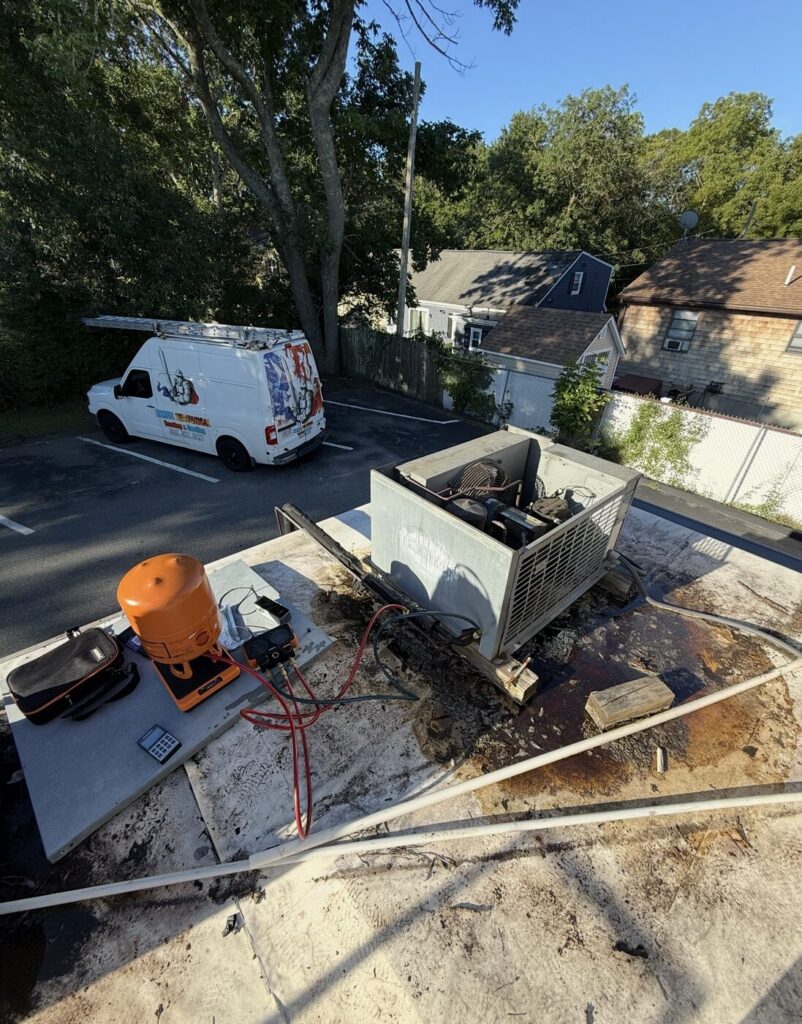
- The truck carries recovery equipment, nitrogen, a vacuum pump and micron gauge, digital gauges, an electronic leak detector, coil chemicals, and stocked capacitors, contactors, relays, fan motors, gaskets, and Schrader cores. Most calls get fixed on the first visit instead of stalling on a parts run.
We promise dispatch and effort, not miracles. If a part has to come from a distributor we say so on the phone and help you plan around it. See emergency refrigeration repair for what an after-hours call looks like end to end.
What to expect on a service call
Every visit runs the same sequence. The tech walks the equipment with whoever is in charge and gets the history: what changed, what noise started, when the temperature began drifting. Power gets locked out. Then diagnostics: amp draw against nameplate, superheat and subcooling, temperature split across the evaporator, defrost termination behavior, electronic leak detection, and a nitrogen pressure test if a leak is suspected. You get the findings and the number before any repair starts, including the honest comparison when a unit is near the end of its life. If repairing a 15-year-old cabinet only buys another season, we say that instead of selling you the repair.
Before we leave, we run the unit and watch it pull down to temperature rather than declaring victory at the control panel. Anytime we recover refrigerant the Schrader cores get replaced on reassembly, because a reused core is how an owner ends up paying to chase a slow leak six months later. You get photos of what failed and what went in, plus a written ticket with the repair, the refrigerant handled, and the readings, which is what an inspector or an insurance adjuster asks for later. Then we clean up. Quarterly refrigeration maintenance is how our steadiest accounts cut emergency calls down, and full-kitchen coverage lives under restaurant refrigeration service.
The compliance side we keep you clear of
Massachusetts food establishments operate under 105 CMR 590, which adopts the 2013 FDA Food Code, and enforcement is local: your city or town Board of Health inspects you. Rhode Island operates under 216-RICR-50-10-1, which adopts the 2022 FDA Food Code, enforced centrally by the Rhode Island Department of Health. Both states hold TCS foods at 41 degrees Fahrenheit or below. For frozen product the code says kept frozen; the 0 degree figure everyone quotes is an industry quality target, not a legal one.
On the refrigerant side, Massachusetts runs its own Refrigerant Management Program under 310 CMR 7.74, with recordkeeping and leak-rate obligations above certain charge sizes, which is why we document every recovery, charge, and leak test on systems that fall under it. The federal AIM Act phase-down continues to reshape what is available for new equipment, with elements under active EPA reconsideration as of late 2025. For commercial refrigeration the practical replacements are R-448A, R-449A, and naturals. If your equipment is on R-404A and needs meaningful refrigerant work, we lay out the retrofit math against replacement so you can decide with real numbers.
Talk to a real person
Armus Refrigeration
Address: 88 Mill Street, New Bedford, MA 02740
Phone, 24/7 for emergencies: 508-521-9477
Email: armusinfo@gmail.com
Hours: open 24/7 – nights, weekends and holidays. Emergency service around the clock, including nights, weekends, and holidays.
Call 508-521-9477, or use the contact page for scheduled work and maintenance quotes. We answer.
Common questions about Armus Refrigeration
How long has Armus Refrigeration been in business?
We have been servicing commercial refrigeration equipment out of New Bedford, Massachusetts for years, working across Southeastern Massachusetts, the Cape, and Rhode Island.
Are your technicians EPA certified?
Yes. Our crew holds EPA Section 608 Universal certification. Type II is the minimum required for most commercial refrigeration, and Universal covers Type I, Type II, and Type III. Section 608 certification does not expire.
Are you licensed and insured in both Massachusetts and Rhode Island?
Yes. We hold the refrigeration licensing required by the Massachusetts Board of State Examiners of Refrigeration Technicians and by the Rhode Island Department of Labor and Training Mechanical Trades Board. We carry $1 million general liability plus workers compensation and provide a Certificate of Insurance on request.
Do you really answer the phone at night?
Yes. 508-521-9477 is answered 24 hours a day for emergencies. Inside our South Coast core service area a technician is usually on the way within the hour, and we give an honest arrival estimate for the outer Cape and farther points in Rhode Island.
Do you sell refrigeration equipment?
No. We repair, maintain, and install, but we do not sell equipment, so nothing rides on a recommendation to replace instead of repair. When you do need a new unit we will point you at an honest distributor and handle the installation.