You flipped on the lights, went to fill the first cold drink of the day, and the bin is empty. When a commercial ice machine stops making ice right before the rush, it feels like an emergency — and sometimes it is. But a good number of these calls come down to something simple you can check in a few minutes, so take a breath and let’s walk through it the way a tech would.
Below are the seven most common reasons an ice machine not making ice quits on you, roughly in the order worth checking. A few you can safely handle yourself. A few are a clear sign to stop and get a pro on the phone — and I’ll tell you which is which.
First, Confirm It’s Actually the Ice Maker
Before you touch anything, look and listen. Is the machine powered on and lit up? Do you hear the compressor or water running? If the unit is completely dead, check the breaker and the wall outlet first — a tripped breaker or a bumped power switch is the single most common “why is my ice machine not working” cause we see. If it powers up and runs a cycle but drops no ice, work through the list below.
7 Things to Check When Your Ice Machine Isn’t Making Ice
- The water supply and shut-off valve. No water in means no ice out. Trace the water line back to the wall and make sure the shut-off valve is fully open — it’s easy for it to get bumped closed during cleaning or a delivery. Confirm the building water is on and that no one shut it off overnight. This is safe to check yourself and fixes more no-ice calls than owners expect.
- A clogged water filter. Most commercial units have an inline water filter that chokes off flow as it clogs — especially in our hard-water areas around New Bedford and Fall River. If your filter is past its schedule (usually every 6 months), swap the cartridge. A starved machine will make thin, small, or no cubes. Owner-doable.
- Low water flow at the float or inlet. Even with the valve open and a fresh filter, mineral buildup or a weak water inlet valve can leave the machine short on water. If flow looks like a trickle, or the reservoir/float trough isn’t filling, note it — you can rule out the filter and valve yourself, but a failing inlet valve is a pro replacement.
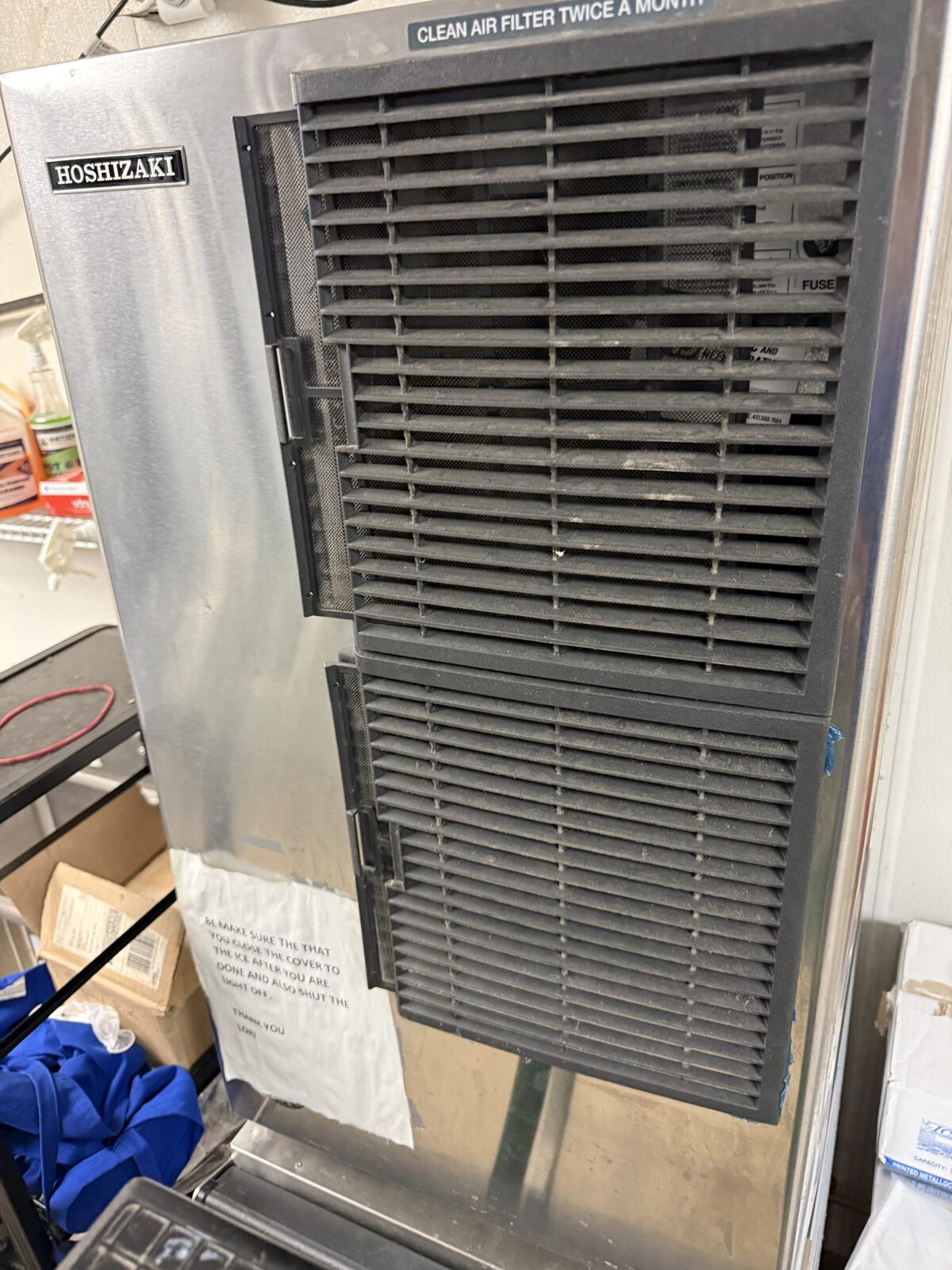
- A dirty condenser coil. This is the big one. An air-cooled ice machine dumps heat through a condenser coil, and in a kitchen that coil packs with grease, flour, and dust fast. When it’s blocked, the machine can’t reject heat, so it stops freezing water into ice. You can carefully vacuum or brush the coil with the power off, but if it’s caked with grease, that’s a professional deep clean — the fins bend easily and a bad cleaning does more harm than good.
- High ambient temperature and poor airflow. Ice machines are rated for a temperature and airflow window. Shove one into a hot back corner, block the intake with boxes, or let the room climb past the mid-90s and it simply can’t make ice at spec. Pull anything crowding the vents, give it a few inches of breathing room, and make sure exhaust from other equipment isn’t blowing at it. Free to fix, and it’s a frequent summer culprit.
- The bin control or thermostat sensing “full.” Every machine has a bin control — a sensor or paddle that stops production when the bin is full. If that sensor is stuck, iced over, or misreads, the machine thinks there’s plenty of ice and shuts down harvesting. Wipe the sensor area, make sure nothing is blocking the paddle, and try a power-cycle (off for a couple of minutes, then on). If it still won’t run a cycle, the control likely needs a tech.
- Scale and lime buildup inside. Over months, minerals coat the evaporator, water lines, and sensors — the machine makes cloudy, soft, or no ice, and cycles get longer. A descaling cleaning often brings a struggling unit back. If you’re also seeing pink or black slime, that’s a separate sanitation issue; here’s more on ice machine cleaning and mold removal. A light descale is owner-doable with the right solution; heavy scale usually means a professional strip-down cleaning.
If your machine is still producing but far less than it should — thin cubes, long cycles, half-empty bin by mid-shift — that’s often a slightly different diagnosis. Our guide to a commercial ice machine making ice slowly walks through that specific slowdown.
When to Stop and Call a Pro
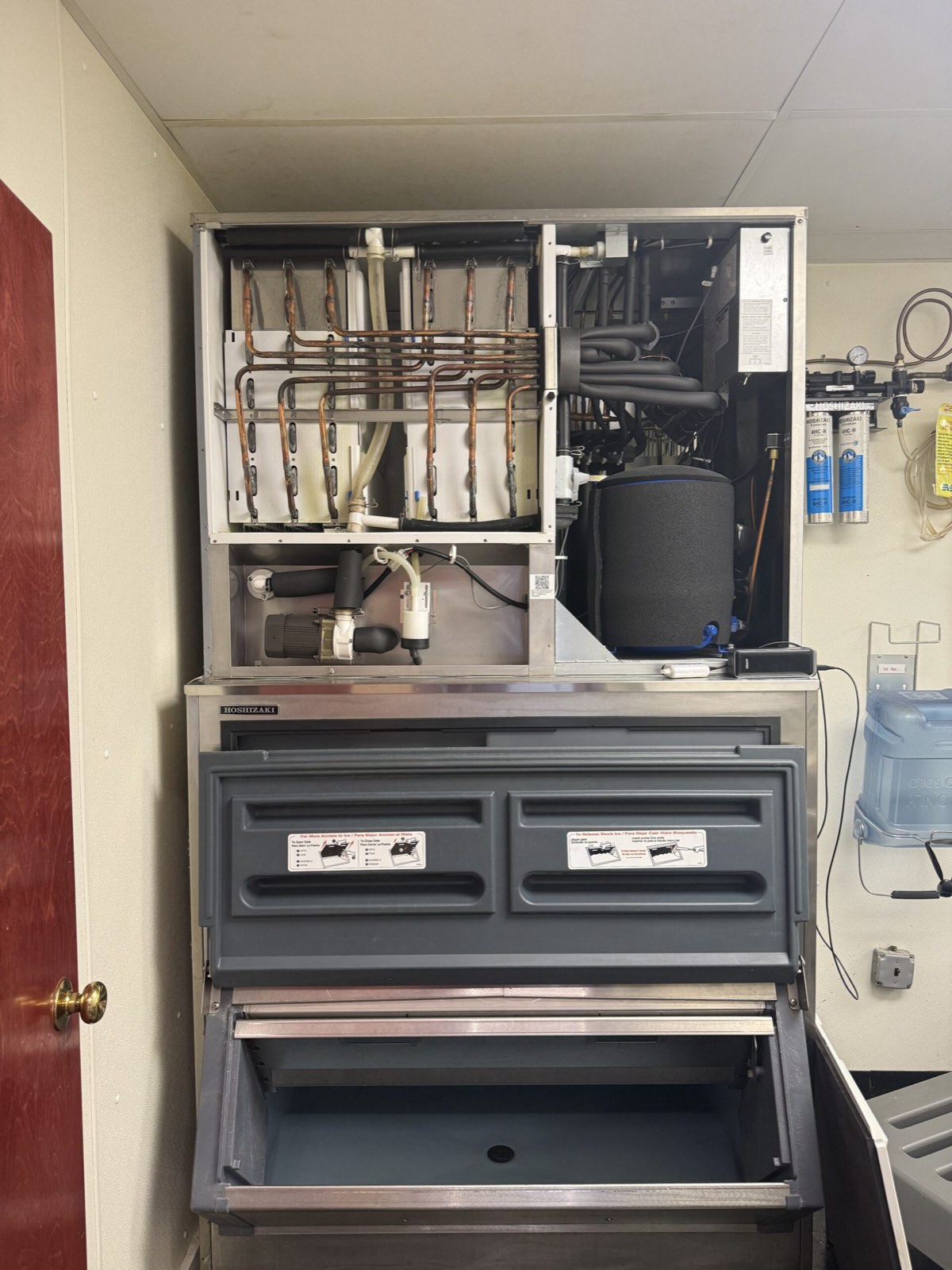
The checks above are safe. Past that point, you’re into the parts of the machine where guessing costs you money — or your warranty. Call a technician when:
- The condenser is caked with grease, or cleaning it didn’t restore ice production.
- You hear the compressor short-cycling, clicking, or not starting at all.
- There’s water pooling under the unit, or you suspect a refrigerant issue (warm to the touch, hissing, oily residue near lines).
- The bin control or control board doesn’t respond after a power-cycle.
- The water inlet valve, pump, or float assembly looks like the problem.
Anything involving refrigerant, the sealed system, or the control board is not a DIY job — those need EPA-certified hands and the right gauges. When you’ve run out of safe checks, that’s the moment to bring in commercial ice machine repair. If the machine feeds a bar, a busy kitchen, or a coffee and donut counter that can’t run without ice, don’t wait it out — treat it as emergency refrigeration repair and get on the schedule same-day.
How to Keep It From Happening Again
Most no-ice calls trace back to maintenance that slipped. Put the condenser coil on a monthly cleaning schedule, change the water filter every six months, and descale twice a year — more often on our hard water. Keep the area around the unit clear so it can breathe. A machine that’s cleaned on a schedule quietly makes ice for years; a neglected one fails on the hottest, busiest day of summer. For a deeper rundown of what causes an ice machine not making ice and how repair works, that page has you covered.
FAQ
Why did my commercial ice machine suddenly stop making ice overnight?
The most common overnight cause is a change that happened at closing — a water shut-off valve bumped closed, a tripped breaker, or the bin control reading “full” when it isn’t. Check power, water supply, and the bin sensor first. If all three are fine and the machine still won’t harvest a cycle, it’s likely a component failure that needs a technician.
Can I fix an ice machine that isn’t making ice myself?
Some of it, yes — checking the water valve, changing the filter, clearing airflow, wiping the bin sensor, and a light descale are all owner-safe. What you shouldn’t touch is the refrigerant system, the compressor, the water inlet valve, or the control board. If your safe checks don’t restore ice within a cycle or two, stop there and call a pro rather than risk a bigger repair.
How fast can someone come out if my restaurant has no ice?
For a food-service business, no ice is a same-day problem, and that’s how we treat it. If your unit is down during service, call it in as urgent — we prioritize commercial kitchens, bars, and coffee shops across New Bedford, Fall River, and the surrounding area so you’re not stuck buying bagged ice for days.
Still not cooling? Don’t risk your inventory. Call 508-521-9477 for same-day commercial refrigeration repair across New Bedford, Fall River, and Southeastern Mass & Rhode Island — we diagnose fast and get you back up.
You flipped on the lights, went to fill the first cold drink of the day, and the bin is empty. When a commercial ice machine stops making ice right before the rush, it feels like an emergency — and sometimes it is. But a good number of these calls come down to something simple you can check in a few minutes, so take a breath and let’s walk through it the way a tech would.
Below are the seven most common reasons an ice machine not making ice quits on you, roughly in the order worth checking. A few you can safely handle yourself. A few are a clear sign to stop and get a pro on the phone — and I’ll tell you which is which.
First, Confirm It’s Actually the Ice Maker
Before you touch anything, look and listen. Is the machine powered on and lit up? Do you hear the compressor or water running? If the unit is completely dead, check the breaker and the wall outlet first — a tripped breaker or a bumped power switch is the single most common “why is my ice machine not working” cause we see. If it powers up and runs a cycle but drops no ice, work through the list below.
7 Things to Check When Your Ice Machine Isn’t Making Ice
- The water supply and shut-off valve. No water in means no ice out. Trace the water line back to the wall and make sure the shut-off valve is fully open — it’s easy for it to get bumped closed during cleaning or a delivery. Confirm the building water is on and that no one shut it off overnight. This is safe to check yourself and fixes more no-ice calls than owners expect.
- A clogged water filter. Most commercial units have an inline water filter that chokes off flow as it clogs — especially in our hard-water areas around New Bedford and Fall River. If your filter is past its schedule (usually every 6 months), swap the cartridge. A starved machine will make thin, small, or no cubes. Owner-doable.
- Low water flow at the float or inlet. Even with the valve open and a fresh filter, mineral buildup or a weak water inlet valve can leave the machine short on water. If flow looks like a trickle, or the reservoir/float trough isn’t filling, note it — you can rule out the filter and valve yourself, but a failing inlet valve is a pro replacement.
- A dirty condenser coil. This is the big one. An air-cooled ice machine dumps heat through a condenser coil, and in a kitchen that coil packs with grease, flour, and dust fast. When it’s blocked, the machine can’t reject heat, so it stops freezing water into ice. You can carefully vacuum or brush the coil with the power off, but if it’s caked with grease, that’s a professional deep clean — the fins bend easily and a bad cleaning does more harm than good.
- High ambient temperature and poor airflow. Ice machines are rated for a temperature and airflow window. Shove one into a hot back corner, block the intake with boxes, or let the room climb past the mid-90s and it simply can’t make ice at spec. Pull anything crowding the vents, give it a few inches of breathing room, and make sure exhaust from other equipment isn’t blowing at it. Free to fix, and it’s a frequent summer culprit.
- The bin control or thermostat sensing “full.” Every machine has a bin control — a sensor or paddle that stops production when the bin is full. If that sensor is stuck, iced over, or misreads, the machine thinks there’s plenty of ice and shuts down harvesting. Wipe the sensor area, make sure nothing is blocking the paddle, and try a power-cycle (off for a couple of minutes, then on). If it still won’t run a cycle, the control likely needs a tech.
- Scale and lime buildup inside. Over months, minerals coat the evaporator, water lines, and sensors — the machine makes cloudy, soft, or no ice, and cycles get longer. A descaling cleaning often brings a struggling unit back. If you’re also seeing pink or black slime, that’s a separate sanitation issue; here’s more on ice machine cleaning and mold removal. A light descale is owner-doable with the right solution; heavy scale usually means a professional strip-down cleaning.
If your machine is still producing but far less than it should — thin cubes, long cycles, half-empty bin by mid-shift — that’s often a slightly different diagnosis. Our guide to a commercial ice machine making ice slowly walks through that specific slowdown.
When to Stop and Call a Pro
The checks above are safe. Past that point, you’re into the parts of the machine where guessing costs you money — or your warranty. Call a technician when:
- The condenser is caked with grease, or cleaning it didn’t restore ice production.
- You hear the compressor short-cycling, clicking, or not starting at all.
- There’s water pooling under the unit, or you suspect a refrigerant issue (warm to the touch, hissing, oily residue near lines).
- The bin control or control board doesn’t respond after a power-cycle.
- The water inlet valve, pump, or float assembly looks like the problem.
Anything involving refrigerant, the sealed system, or the control board is not a DIY job — those need EPA-certified hands and the right gauges. When you’ve run out of safe checks, that’s the moment to bring in commercial ice machine repair. If the machine feeds a bar, a busy kitchen, or a coffee and donut counter that can’t run without ice, don’t wait it out — treat it as emergency refrigeration repair and get on the schedule same-day.
How to Keep It From Happening Again
Most no-ice calls trace back to maintenance that slipped. Put the condenser coil on a monthly cleaning schedule, change the water filter every six months, and descale twice a year — more often on our hard water. Keep the area around the unit clear so it can breathe. A machine that’s cleaned on a schedule quietly makes ice for years; a neglected one fails on the hottest, busiest day of summer. For a deeper rundown of what causes an ice machine not making ice and how repair works, that page has you covered.
FAQ
Why did my commercial ice machine suddenly stop making ice overnight?
The most common overnight cause is a change that happened at closing — a water shut-off valve bumped closed, a tripped breaker, or the bin control reading “full” when it isn’t. Check power, water supply, and the bin sensor first. If all three are fine and the machine still won’t harvest a cycle, it’s likely a component failure that needs a technician.
Can I fix an ice machine that isn’t making ice myself?
Some of it, yes — checking the water valve, changing the filter, clearing airflow, wiping the bin sensor, and a light descale are all owner-safe. What you shouldn’t touch is the refrigerant system, the compressor, the water inlet valve, or the control board. If your safe checks don’t restore ice within a cycle or two, stop there and call a pro rather than risk a bigger repair.
How fast can someone come out if my restaurant has no ice?
For a food-service business, no ice is a same-day problem, and that’s how we treat it. If your unit is down during service, call it in as urgent — we prioritize commercial kitchens, bars, and coffee shops across New Bedford, Fall River, and the surrounding area so you’re not stuck buying bagged ice for days.
Still not cooling? Don’t risk your inventory. Call 508-521-9477 for same-day commercial refrigeration repair across New Bedford, Fall River, and Southeastern Mass & Rhode Island — we diagnose fast and get you back up.