Walk-in cooler maintenance, and walk-in freezer maintenance along with it, is the planned visit that keeps the one piece of refrigeration a kitchen cannot work around from turning into an emergency call. A reach-in that quits can be emptied into the unit beside it. A walk-in that quits on a Friday in July takes the whole inventory with it. Armus Refrigeration maintains walk-in coolers and walk-in freezers from our shop at 88 Mill St in New Bedford across Southeastern Massachusetts, the South Shore, Cape Cod, Greater Boston, Worcester County and Rhode Island. Every technician is EPA Section 608 certified and we hold refrigeration licenses in both Massachusetts and Rhode Island. On a visit the technician cleans the coils, tests every component that carries a load, measures how the system is running and leaves you a written record of what was found. To put a walk-in on a schedule, or if a box is running warm right now, call 508-521-9477. The line is answered 24 hours a day, 7 days a week.
What Walk-In Cooler Maintenance Covers on a Planned Visit
A walk-in is three things bolted together: a condensing unit that rejects heat, an evaporator that absorbs it, and an insulated box with a door. A maintenance visit goes through all three in the same order every time, because a problem in one usually shows up as a symptom in another. The checklist is the same whether the box is a Kolpak, Bally, Norlake or Master-Bilt, and whether the refrigeration is Heatcraft (Bohn and Larkin), KeepRite or another make with a Copeland compressor on it.
The condensing unit, on the roof or out back
The condenser coil is cleaned first, since it is the part that gets dirty fastest and costs the most when it is ignored. Behind a restaurant it loads with kitchen grease that turns dust into a felt mat. On a roof it packs with cottonwood seed in June and leaves in October. Within a mile of Buzzards Bay or Narragansett Bay it also carries salt, which eats the aluminum fins. With the coil clean we check the condenser fan motor and blade, test the run and start capacitors against their rating, look at the contactor points for pitting, tighten the electrical connections, confirm the crankcase heater is working and check the low-ambient head pressure control that lets the unit run through a New England winter. Compressor amp draw is logged against the nameplate, and suction and head pressures are read with the box at temperature.
The evaporator, inside the box
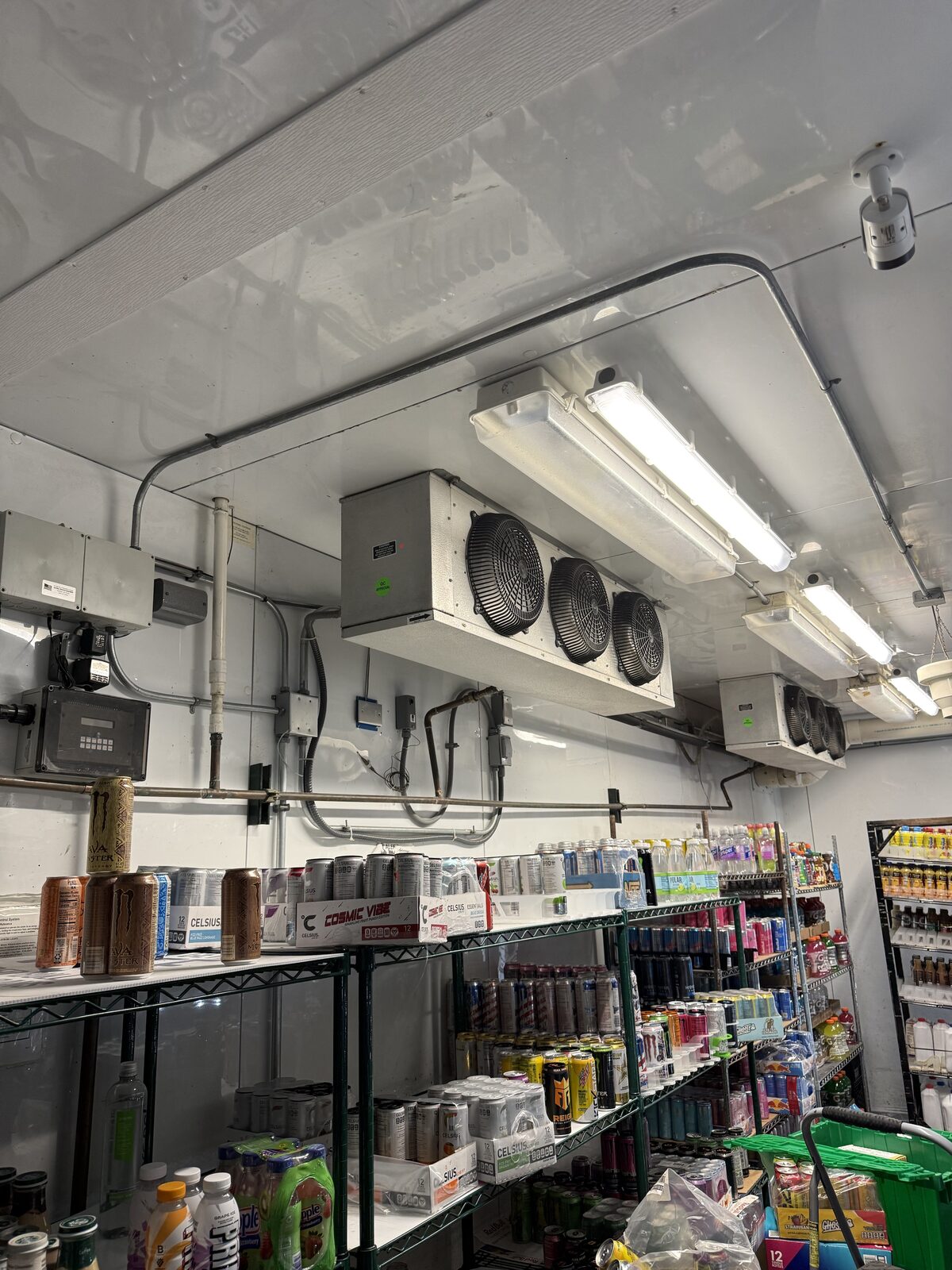
Inside the box the evaporator coil is inspected and cleaned, the fan motors and blades are checked for noise, play and correct rotation, and the drain pan and drain line are cleared and flushed. A walk-in cooler that drips from the coil onto product almost always has a slimed drain, and it takes ten minutes to prevent. We check the expansion valve bulb for a tight, insulated mount, measure superheat at the coil outlet to confirm the valve is feeding properly, and look at the frost pattern, because a coil that frosts on one end only is telling you about refrigerant charge or airflow weeks before the box runs warm.
The box: door, panels and floor
Then the box itself. Door gaskets are checked for splits at the hinge-side corners where they fail first, the sweep is checked against the threshold, hinges and the closer are adjusted so the door pulls itself shut, and the latch and the inside safety release are tested. Strip curtains are looked at, panel seams and ceiling penetrations are checked for open caulk, and the floor is checked for soft spots and standing water. The box thermometer is verified against a calibrated one, since that is the reading your staff and the health inspector both rely on. Door problems that go beyond an adjustment are covered on our walk-in door repair page, and a floor that is lifting or delaminating is covered under walk-in floor repair.
Walk-In Freezer Maintenance: The Defrost System Comes First
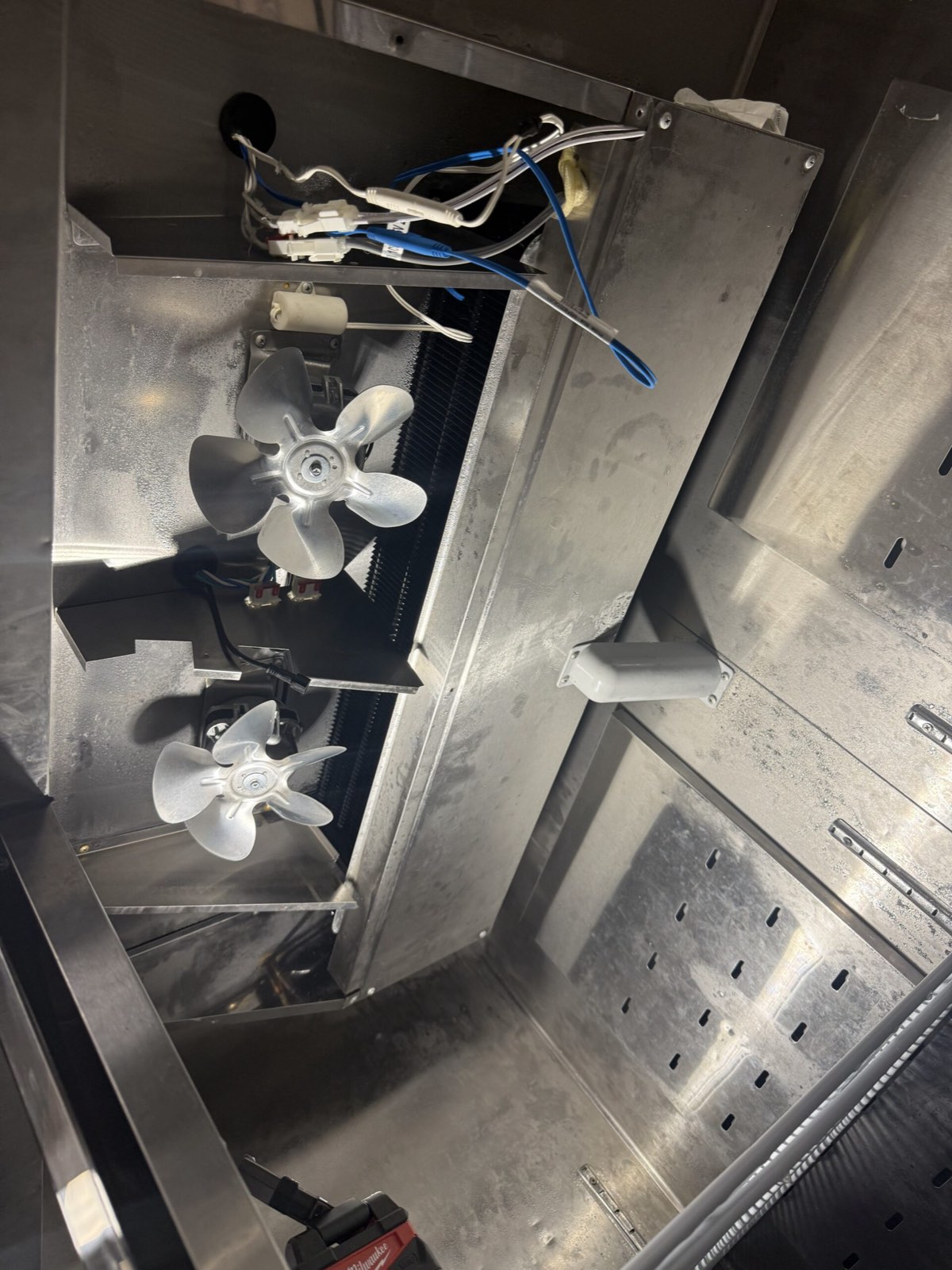
Walk-in freezer maintenance includes everything above plus the systems a cooler does not have, and those systems are where freezers fail. A freezer coil runs far below 32°F, so every bit of moisture that enters the box ends up on it as frost, and a set of electric heaters has to clear that frost several times a day. On a maintenance visit we put an amp clamp on each defrost heater to confirm it is drawing what it should, check that the termination thermostat ends the cycle when the coil is clear, confirm the fan delay keeps the fans off until the coil is cold again, and verify the number and length of defrosts on the time clock or controller. One open heater leaves a patch of coil that never clears, and that patch grows.
The rest of the freezer list is about water and air. The drain line heater is tested, because a freezer drain with a dead heater freezes solid and sends the next defrost’s meltwater onto the floor as a sheet of ice. The door frame heater and the heated pressure relief port are checked: without the first the gasket freezes to the frame, and without the second the door becomes hard to open after every defrost. Ice on the ceiling near the fans, frost growing around the door, or snow on the product are all signs that one of these has already failed. If you are seeing any of them now, our freezer frost and ice buildup page explains each pattern, how to defrost a walk-in freezer safely covers what to do tonight, and the repair itself is on our walk-in freezer repair page.
What the Numbers on the Maintenance Report Mean
Every visit ends with a report, and the report is the part of maintenance that pays for itself over time. We record box temperature against setpoint, suction and head pressure, superheat, compressor and fan motor amps, defrost heater amps on freezers, and how long the box takes to pull back down after a defrost. One set of readings tells us the system is healthy today. Three or four sets in a row show a trend: a condenser fan motor whose amp draw creeps up every visit is going to fail, and it can be replaced on a Tuesday morning instead of a Saturday night. Any refrigerant added is recorded with the amount and the reason, which is the record the EPA leak repair requirements and state rules expect an owner to be able to produce, and the temperature log gives you something to hand an inspector who asks how you know the box holds 41°F or below, the cold-holding limit in the FDA Food Code that Massachusetts and Rhode Island both enforce.
How Often a Walk-In Needs Service
The honest answer depends on what surrounds the condensing unit and how often the door opens. A restaurant walk-in with the condensing unit near the kitchen exhaust needs a visit every three months. A box in a school, a church kitchen, a florist or a package store, with cleaner air and lighter traffic, is usually fine on two visits a year, one before summer and one before winter. Walk-in freezers need the defrost system checked on every visit regardless of schedule. Seasonal operations on Cape Cod and along the beaches need a start-up visit before the season, when a unit that sat idle all winter is most likely to show a seized fan motor or a leak, and a shutdown visit after it. Condensing units close to salt water benefit from a fresh-water coil rinse between our visits. If your walk-in has not been serviced in the last six months, call 508-521-9477 and we will put it on the next route through your town.
What your staff can do between visits
Most of what keeps a walk-in healthy between visits costs nothing. Keep product six inches off the evaporator and out of the path of the fans so air can circulate. Keep the door shut and report a torn gasket or a door that no longer closes on its own the day it happens. Look at the evaporator coil once a week; frost on a cooler coil or a freezer coil that looks like a snowbank is an early warning. Keep cardboard, crates and leaves away from the condensing unit. Write the box temperature down twice a day. Do not chip ice off a coil or a floor with anything sharp, and do not hose down the condensing unit while it is powered. Our month-by-month refrigeration maintenance calendar lays these checks out for a kitchen crew.
Maintenance Versus Repair: What a Plan Actually Prevents
Most of the walk-in failures we are called to at night were visible months earlier. A condenser coil that was never cleaned raises head pressure, the compressor runs hot for a season, and it fails on the first ninety-degree day. A contactor with burned points welds shut or drops a leg of power. A capacitor drifts out of range and the fan motor it serves overheats. A defrost heater opens and a freezer coil closes with ice over two weeks. All of these are found by a meter and a pair of eyes on a planned visit, and all of them cost less to fix before they take the box down. Maintenance does not prevent everything. A compressor can still fail from age, and a refrigerant line can still rub through where nobody can see it. What a plan does is remove the failures that give warning, which is most of them.
When a visit turns up a failing part, we repair it on the same visit if the part is on the truck, and fan motors, capacitors, contactors, defrost heaters, termination switches, gaskets and door hardware usually are. Larger findings are quoted before any work is done. Those repairs are described on our walk-in cooler repair page and, for the compressor itself, on refrigeration compressor repair. For a box that is down right now, the 24-hour emergency refrigeration line is the faster route.
Maintenance is also how you find out in time that a box is near the end. A walk-in running an older refrigerant with a slow leak, panels that have taken on water, or a condensing unit that has been repaired every summer for three years is a replacement to plan and budget for, and the readings from a year of visits make that case in numbers. Our walk-in installation and replacement page covers that work, and the walk-in cooler and freezer cost guide covers what new boxes and refrigeration systems run.
Who We Maintain Walk-Ins For
Restaurants are the largest group, and their walk-ins live the hardest life: grease in the air, a door that opens hundreds of times a shift, and product loaded warm. Our restaurant refrigeration service puts the walk-in, the reach-ins, the prep tables and the ice machine on one visit. Fish markets and seafood processors around the New Bedford and Fall River waterfronts run wet, salty boxes where drains, door hardware and evaporator fan motors need the most attention. Supermarkets, convenience stores and package stores depend on walk-in beer and dairy coolers with glass doors, where door heaters and gaskets are the usual finds; larger stores are covered under grocery store refrigeration.
Schools, nursing homes and hospital kitchens need the paperwork as much as the service, and we schedule those around meal times and vacations. Florists hold coolers at higher humidity and a narrow temperature band. Caterers, function halls, churches and food pantries have boxes that sit lightly used for weeks and are then filled in a day, which is exactly when a marginal system gives out. If you also want the reach-ins and ice machines in the building looked after, our commercial refrigeration maintenance plans cover the whole cold side, and ice machines are cleaned and descaled as described on our ice machine cleaning page.
Where We Run Walk-In Maintenance Routes
Planned maintenance is routed by area so that travel is shared across several customers. From New Bedford we cover Fall River, Dartmouth, Fairhaven, Wareham and Taunton on short notice. The South Shore through Plymouth and Cape Cod are scheduled together, with the Cape’s seasonal start-ups booked in April and May. Greater Boston and the Route 128 belt are regular runs, including the office-park kitchens described on our Canton refrigeration maintenance page. In Rhode Island we route Providence, Cranston, Warwick, East Providence and Newport, listed in full on the Rhode Island commercial refrigeration page. You get a date and an arrival window, and a technician who has the last visit’s readings in hand.
Walk-In Maintenance Questions We Get
How often should a walk-in cooler be serviced?
Twice a year is the minimum for any walk-in cooler, once before summer and once before winter. A restaurant walk-in should be serviced every three months, because kitchen grease loads the condenser coil quickly and a door that opens hundreds of times a day wears gaskets, hinges and closers faster. A box in a school, church or florist with clean air and light traffic does well on two visits a year. Walk-in freezers should have the defrost system checked on every visit, whatever the schedule.
What does walk-in freezer maintenance include that cooler maintenance does not?
The defrost system and everything that deals with meltwater and frost. On a freezer we measure the amp draw of each defrost heater, check the termination thermostat and the fan delay, verify the defrost schedule on the time clock or controller, test the drain line heater, and check the door frame heater and the heated pressure relief port. A cooler usually defrosts on its own during the off cycle and has none of those parts. Freezer visits take a little longer for that reason.
Can our own staff clean the condenser coil instead of calling a technician?
Staff can and should keep the area around the condensing unit clear and brush loose lint and leaves off the face of the coil with the power off. A proper cleaning is different: grease-loaded coils need a coil cleaner and a controlled rinse from the inside out, fins are easy to fold flat with a pressure washer, and the electrical components sit inches away. Staff cleaning between visits helps. It does not replace the visit, because the cleaning is only one item on the list and the readings are what tell you the system is healthy.
Does walk-in cooler maintenance lower the electric bill?
Yes, when the maintenance fixes something that was making the system run longer. A dirty condenser coil raises head pressure, so the compressor draws more power and runs more hours to do the same work. A torn gasket or a door that does not close lets warm, wet air in around the clock. An evaporator coil with frost or dirt on it moves less heat per hour. Each of those shows up as extra run time, and run time is what you pay for. The saving depends on how far the box had drifted before the visit.
How long does a walk-in maintenance visit take, and does the box have to be emptied?
A single walk-in cooler with an accessible condensing unit takes about an hour to an hour and a half; a freezer or a rooftop unit takes longer. The box does not have to be emptied. We ask that product be kept off the floor under the evaporator and that we have a clear path to the coil and the drain. The refrigeration is off only for short periods during the visit, and we schedule around deliveries and service hours so the door is not standing open during a rush.
What does a walk-in maintenance plan cost?
It is priced per visit from the number of boxes, whether they are coolers or freezers, where the condensing units sit, and how many visits a year the site needs. A ground-level unit behind the building is quicker to service than one on a roof with no hatch, and a freezer takes longer than a cooler. We walk the equipment with you first and quote the plan from what is actually there, including any repairs we would recommend doing at the start so the plan begins with a healthy system.
Do you maintain walk-ins that another company installed?
Yes. Most of the walk-ins we maintain were installed by someone else, sometimes decades ago. The first visit takes longer because we record the equipment: box size, condensing unit and evaporator model and serial numbers, refrigerant type, control settings and the condition of each component. That baseline is what later readings are compared against, and it means a technician arriving for a repair already knows the system.
Ready to put your walk-in cooler or freezer on a maintenance schedule? Call Armus Refrigeration at 508-521-9477. We will look at the equipment with you, tell you what it needs and how often, and quote the plan from what we find.