Walk-In Cooler Repair Revere, MA: Getting Your Cold Storage Back Online Fast
When your walk-in cooler in Revere stops cooling, you’re not just dealing with a broken machine; you’re losing inventory, and every hour matters. We’re the guys who show up, look at the compressor, and get the cold back in your walk-in.
Emergency Walk-In Cooler Repair in Revere, MA
For more on refrigerant handling regulations, see EPA Section 608 certification.
Look, I’ve been running this operation—Armus Mechanical and Armus Refrigeration—for over fifteen years. I’ve seen walk-in coolers go down in everything from a busy spot on Route 1 to a small market down near the waterfront. When you call us, especially after hours, I know why. Your walk-in freezer is holding fifty pounds of seafood, or your walk-in cooler is stocked with perishable produce for the next day’s service. Losing that cold means losing cash fast.
We treat it like an emergency because it is. We’re local to the area—I know the difference between the traffic patterns in Revere and what it’s like getting across to the South Shore. When you need walk-in cooler repair in Revere, you need someone who knows how to bypass the marketing fluff and just fix the damn thing. That’s what we do. We’re licensed, we’re insured, and we’ve got the EPA 608 certification to handle the refrigerant safely.
If it’s down right now, don’t wait for a “next business day” call-out. You need us on the line. Call us at 508-521-9477. We answer because your operation can’t afford to wait.
What Goes Wrong with a Walk-In Cooler? (The Tech Talk)
For more on AIM Act phase-down, see EPA SNAP-listed refrigerants.
People often call us thinking it’s a simple fix—maybe the door seal is bad. Sometimes it is. Other times, it’s something deeper, and you need a tech who actually understands the mechanics. We aren’t just swapping parts; we’re diagnosing the root cause.
A walk-in cooler system has a few key components. You’ve got the evaporator coil inside the box, that’s where the cooling happens. Then you’ve got the condenser, usually outside, where the heat gets dumped. The whole cycle relies on the compressor running smoothly, moving the refrigerant through the capillary tube and expansion valve. If the compressor is whining or tripping on high pressure, we need to know why. Is it low refrigerant charge? Is the condenser getting clogged with dirt and debris from the Revere humidity? Or is the thermostat sending the wrong signal?
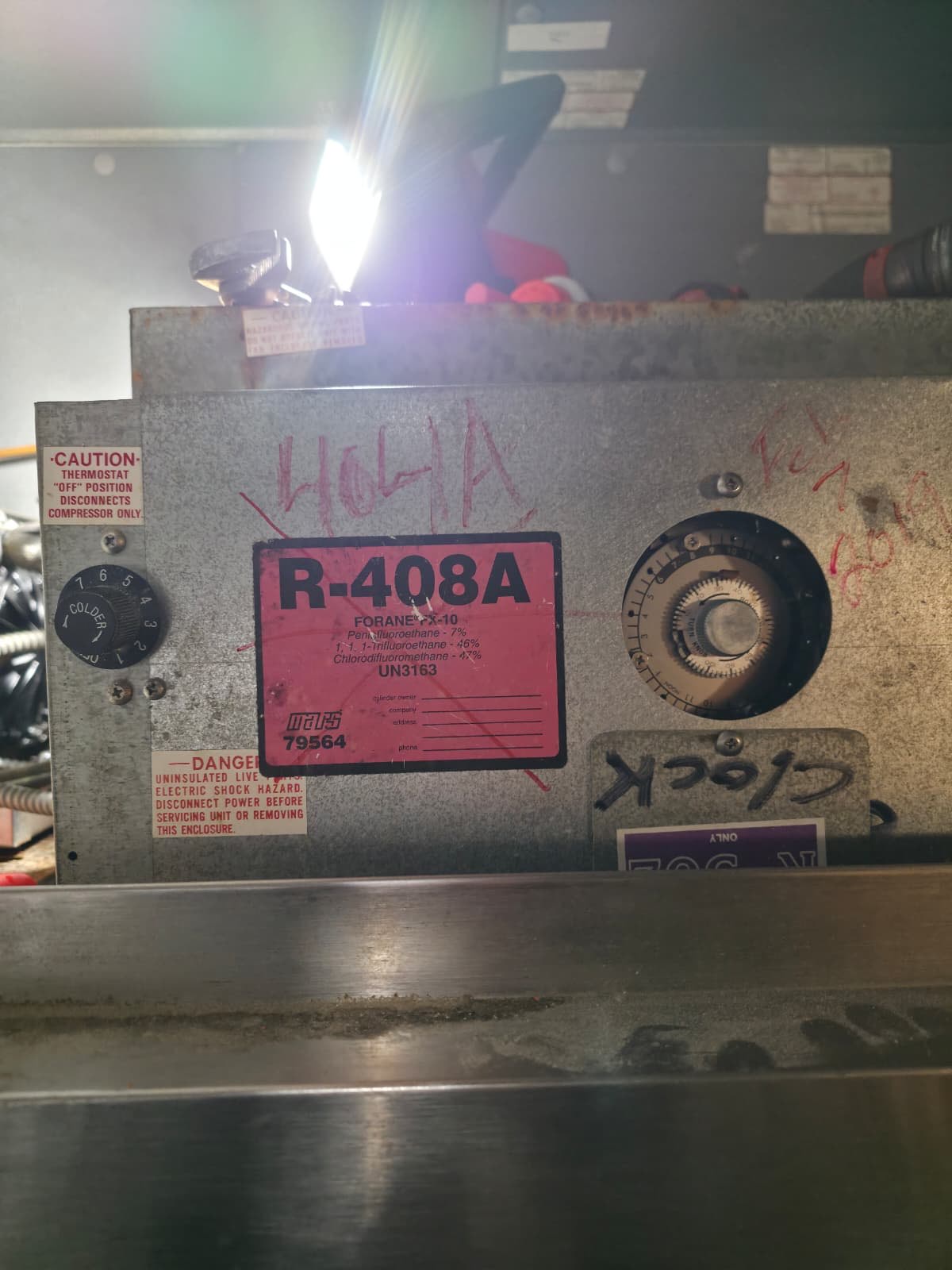
We check the refrigerant pressure readings—high side, low side—and we look at the electrical components, like the defrost cycle timer. It’s not guesswork; it’s following the science of thermodynamics, applied to your specific piece of equipment, whether it’s a True or a Manitowoc unit. We’ll tell you exactly what’s wrong, and more importantly, what we’re going to do to fix it right.
The Scope of Our Walk-In Repair Work
For more on Massachusetts compliance, see MassDEP refrigerant management.
We handle the whole spectrum of commercial cooling. When you say “walk-in cooler repair,” that covers a lot of ground. We deal with walk-in coolers, walk-in freezers, and even the smaller ancillary units like prep tables and glass-door merchandisers, if they’re part of the same setup. But the walk-in is the big one.
If the unit is struggling to maintain temperature, we check the door gaskets first. A bad seal lets in warm air, and that forces the compressor to run non-stop, burning out the motor prematurely. Then there’s the electrical side—we check the contactors, the start capacitors, and the control boards. These things fail, and the whole system goes dark. Sometimes, the problem is surprisingly simple, like a tripped breaker in the main disconnect box that nobody noticed.
We’ve seen it all. We’ve pulled up to a diner on Route 6 last month—a place near the border of what feels like South Boston territory—and their condenser unit was practically coated in grime. The airflow was so restricted, the compressor couldn’t reject heat, and the whole thing shut down due to overheating. Cleaning and clearing that unit was half the battle, then we got the refrigerant flowing right again.
Repair vs. Replacement: Making the Call Right
This is the part I wish every owner understood upfront. When we diagnose a system, we don’t just recommend throwing money at the newest model. We look at the age, the brand, and the cost of the repair versus the cost of a new, comparable unit. If your unit is pushing 18 or 19 years old, and the failure is complex—say, a failed main control board *and* a failing motor—we have to be honest with you. Sometimes, the labor and parts to get an ancient machine running again are more expensive than replacing the whole box with something reliable from a manufacturer like Hoshizaki or Continental.
We build our recommendations on experience, not on a parts markup sheet. We want your operation running reliably for the next decade, not just for the next three months. If we tell you to replace it, it’s because I’ve seen that same failure point on a machine just like yours three times in the last year, and the repair just won’t hold up.
The Armus Difference: Local, Hands-On Service
When you call us, you aren’t talking to a call center reading off a script. You’re talking to me, or one of the techs who’s been on the floor doing this trade for years. We live and work in this region. We know the rhythm of the food service industry here in Massachusetts and Rhode Island. We know that when the market in Revere closes down for the night, you still need to know who can get out there if there’s an issue at 4 AM.
Our focus is simple: immediate, competent repair service for commercial equipment. We don’t waste time talking about “optimization strategies.” We show up, we pull out the gauges, we check the oil levels, we clean the coil fins, and we get that temperature reading back down to where it needs to be. That’s the bottom line for any restaurant owner.
We cover the full spectrum—from walk-in cooler repair in Revere to servicing glass-door merchandisers in nearby Chelsea or even tackling a broken ice machine down near the waterfront. We’re here for the tough calls, the late nights, and the equipment that simply refuses to quit.
Spotting the Trouble: Common Failures and How We Pinpoint the Problem
When a cooler isn’t holding temperature, don’t just throw a wrench at it. A lot of people—especially when they’re stressed and watching food spoil—just guess what’s wrong. That’s a mistake. When we pull up to a spot in Revere, whether it’s a small market or a full-service restaurant, the first thing we do isn’t just to check the thermostat. We check the whole system. We’re looking at the signs. Is the condenser coil coated in enough grime that you could scrape off a month of chowder residue? That’s a common killer. Or maybe the evaporator fan motor is running slow, just enough that the air movement isn’t cycling the cold air across the product properly. Diagnosis isn’t guesswork; it’s following the flow. We check refrigerant pressure at the service ports. If the suction side pressure is suspiciously low, we know the system is losing charge somewhere—a leak, maybe a bad flare nut connection that hasn’t popped off yet. If the head pressure is way too high, we’re looking at a restriction, possibly a partially clogged filter-drier or a failing expansion valve that isn’t metering refrigerant correctly. Knowing the difference between a simple airflow issue and a refrigerant circuit failure saves time and money, especially when you’re staring at thousands of dollars in spoiled prime rib. We’ve seen the tell-tale signs all over the South Shore. Sometimes the issue is as simple as the door gasket. If the seal around the walk-in door has perished—cracked or warped—the cool air just leaks out into the warmer air of the back room, and the compressor runs constantly, burning out prematurely. Before we even touch the compressor, we check the seals. It’s the basics that fail the most.Keeping It Running: The Preventive Maintenance Checklist
A professional setup like the one down near the waterfront in Revere shouldn’t break down because someone skipped cleaning the coils. Preventive maintenance isn’t an upsell; it’s just good shop practice. If you treat your equipment like it’s a set of tools you use once a year, you’re going to end up with a breakdown when you need it most. Our checklist is straightforward: clean, inspect, lubricate, and test. First, the cleaning. We’re talking about the condenser. Those fins get coated with dust, grease, and whatever volatile organic compounds are floating around from the cooking line. If those heat exchange surfaces are choked, the compressor has to work way harder, running hotter and less efficiently, which eats up motor life fast. Next, the evaporator. We blow out the condensate drains and check the fan blades for any buildup that might cause imbalance. Then we move to inspection. We check the electrical components—the contactors, the overload protectors. These parts take a beating from constant cycling, and if the connections are corroded, the unit can trip out randomly, giving the owner no clue why. We test the defrost cycle timing, making sure the heaters are engaging and disengaging at the right intervals for the ambient humidity. Doing this routine check, maybe twice a year, is the best insurance you can buy against a complete shutdown during a busy Saturday night rush.The Equipment We See Every Day: Brands and Models
You might think every walk-in cooler is built the same way, but they aren’t. When we’re out anywhere from Providence to the immediate Revere area, we’re dealing with a mix of gear—some brand new, some running since the late 90s. Knowing the brand helps us know the common failure points on that specific model. We see a lot of walk-ins running on older, heavy-duty compressors, often Copeland or similar industrial-grade units. We work with a variety of brands, from commercial-grade units that are purpose-built for high-throughput kitchens to walk-ins that are retrofitted or sourced from different manufacturers. The principles of refrigeration—the cycle, the pressure differentials—stay the same, but the components change. For instance, a newer unit might use variable speed compressors that offer better efficiency on the gas side compared to the fixed-speed units we used to service constantly. The takeaway here is that we aren’t specialized in just one thing; we’re specialized in *keeping things cold*. We know the common architectures, the parts breakdowns, and the specific quirks of the machinery that keeps your inventory safe, whether it’s a high-end seafood market down by the water or a local diner out in the sticks. We show up, we diagnose the actual failure, and we get the proper machinery back online.What a walk-in cooler repair service call actually covers
When we arrive on a service call, we work through the system in a fixed order so nothing gets skipped. Refrigerant pressures on both the suction and discharge sides. Amp draw on the compressor at start and during steady-state run. Superheat at the evaporator and sub-cooling at the condenser. Evaporator and condenser coil condition, fan motor amp draw and bearing condition, defrost cycle timing and termination, drain line clearance, door gasket seal and door alignment, controls and contactors. The diagnostic is usually 30 to 60 minutes; the repair time depends on what we find.
For commercial walk-ins above 50 pounds of refrigerant charge in Massachusetts, we also document the visit for the operator’s MassDEP Refrigerant Management Program file. RI commercial food establishments need their temperature logs intact and corrective action documented for RIDOH inspections, and our service tickets fit that record set.
Service area and response times for Revere, Ma
Revere, Ma is inside our core dispatch zone. From our base we are usually 20 to 45 minutes out depending on time of day and traffic on Route 6, Route 24, I-195, and I-95. New Bedford, Fall River, Dartmouth, Fairhaven, and the South Coast generally get same-day response on weekday calls placed before noon. Up the Cape and out to Provincetown adds an hour or so. Into Rhode Island — Providence, Warwick, Cranston, Pawtucket, Newport — we are commonly there inside two hours.
Overnight and weekend emergencies are triaged by what is losing inventory fastest. If you have a walk-in full of seafood climbing past 45°F at midnight, you move to the front of the queue. We will tell you straight on the phone what realistic arrival looks like before you commit.