Framingham runs two food economies at once, and they break walk-in coolers in different ways. Downtown, along Concord, Hollis and Waverley Streets, Brazilian padarias, butcher counters and churrascarias cycle walk-in doors dozens of times an hour through a prep day, in storefronts built long before anybody planned a spot for a condenser. Two miles south, the Route 9 and Route 30 retail spread people here call the Golden Triangle carries big-box grocery and chain kitchens whose condensing units sit on flat roofs, taking every MetroWest wind and every single-digit February night.
The downtown box usually fails at the door: flattened gasket, dropped hinge, evaporator packed in ice. The Route 9 rooftop box usually fails at the condenser: snow-blocked intake, no head pressure control, high-pressure lockout. Tell us which Framingham you are in when you call 508-521-9477 and we load the truck accordingly.
Walk-In Cooler Repair Framingham, MA: Getting Your Cold Chain Back Online Fast
When your walk-in cooler stops cooling in Framingham, you aren’t just dealing with a broken appliance; you’re staring down thousands of dollars of spoiled inventory. We get it. Time is literally money when you’re running a busy kitchen.
Emergency Walk-In Cooler Repair in Framingham
For more on refrigerant handling regulations, see EPA Section 608 certification.
Look, I’ve been doing this in Southeastern MA for 20 years. I’ve seen walk-in freezers fail on a hot Tuesday morning when a busy market in the South Coast is relying on them. When that compressor kicks out, or the temperature gauge starts climbing, you need someone who knows what’s going on *right now*. You don’t need a salesperson; you need a tech who can get a diagnosis and fix the damn thing.
That’s where we come in. We handle emergency response for walk-in cooler repair all over Framingham. Whether you’re near Route 9 or down near the edge of town, if it’s holding perishable product, it’s our priority. We’re licensed, insured, and we’re ready to roll. You can call us 24/7—my phone rings constantly during peak season for a reason. When your walk-in stops cooling, every hour matters. We’re standing by.
What to Expect When We Repair Your Walk-In Cooler
For more on AIM Act phase-down, see EPA SNAP-listed refrigerants.
You might be worried about being upsold junk, or waiting half a day for someone who can’t figure out the problem. We keep it straightforward. First, you call. We get an idea of the problem over the phone—is it running but not cooling? Is it tripping a breaker? Is it just warm? That helps us prep.
When we pull up to your Framingham location, we go straight to the diagnosis. We check the basics first: power, airflow across the condenser, and the temperature differential. We’re talking about checking refrigerant pressures, looking at the defrost cycle timer, and testing the evaporator coil for blockages. We don’t guess. We use our experience with brands like True, Beverage-Air, and Manitowoc every day.
If it’s a simple fix—a bad capacitor, a clogged drain line, or a tripped relay—we swap it out, test the system under load, and get you back to normal. If it’s deeper—like a failing compressor or a major electrical component—we’ll tell you straight up. We won’t waste your time or your money.
Common Walk-In Cooler Failures We Fix
For more on Massachusetts compliance, see EPA Section 608 refrigerant rules.
Walk-in coolers and freezers are complex machines, but most failures boil down to a few key spots. Understanding these can help you describe the issue when you call us.
First up: the compressor. This is the heart. If it’s cycling on and off constantly, or if it’s humming but not building pressure, that’s where the issue is. It’s not always the compressor itself; sometimes it’s the start capacitor making it struggle.
Then there’s the cooling cycle itself. Sometimes the issue isn’t the motor; it’s the refrigerant flow. We check the liquid and suction lines, the expansion valve, and the overall pressure readings. Low refrigerant charge? We find the leak, we fix the leak, and then we recharge it correctly. No guesswork on the PSI readings here.
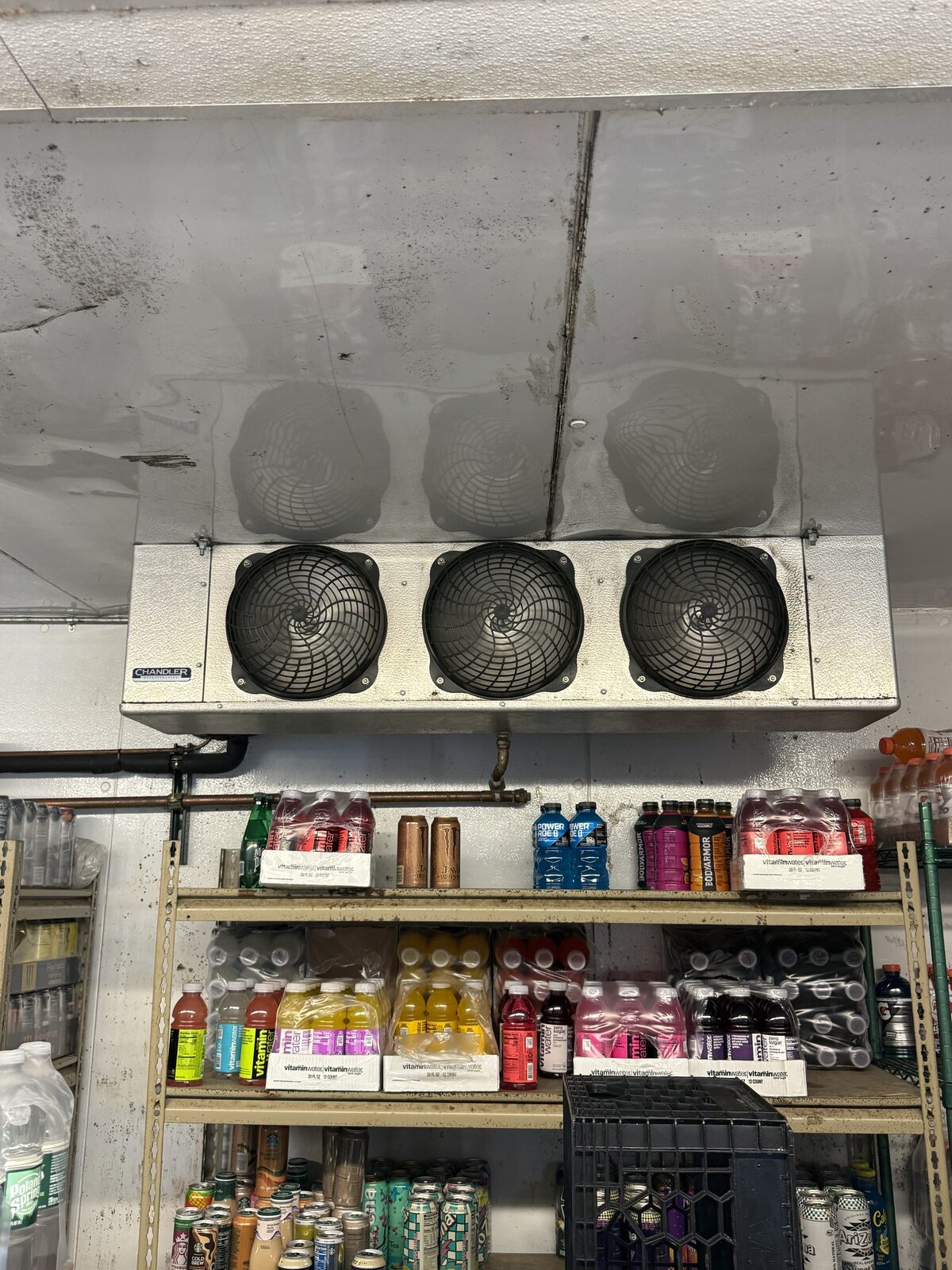
Don’t forget the airflow. If the condenser coils are covered in grime—like the stuff you accumulate around a busy restaurant in downtown Framingham—the unit can’t shed heat, and the whole system starves. Cleaning and servicing those coils is a massive part of keeping things running smooth.
Why Local Experience Matters for Your Framingham Cooler
When you call a national chain, you get a script. When you call us, you get someone who knows the difference between the humidity down by the Cape and the climate up near Providence. We live and work in this area. We know the rhythm of the local food service industry.
I remember last month at a restaurant in Fall River—they were prepping for a huge weekend rush. Their old Hoshizaki walk-in freezer was acting up, cycling erratically. A general HVAC tech would probably just check the thermostat and leave. We dove in. We found a partial blockage in the condensate drain line, combined with a slightly worn-out defrost heater element that was causing minor temperature fluctuations. It was a combination issue, and it needed us to diagnose both the plumbing and the electrical side to get it stable. That’s the kind of deep, practical knowledge you only get from doing this job in this region for decades.
We understand that running a commercial kitchen means zero downtime. When you’re operating in Framingham, you need reliability that matches your business hours. We treat your equipment like it’s ours, because when it fails, you lose product, and that’s a headache no one needs.
Preventative Maintenance: Keeping Your Cooler Running Year-Round
The best repair is the one you never have to make. A good preventative maintenance plan keeps your walk-in cooler running efficiently, which saves you money on energy bills, too. We don’t just wait for the emergency call; we talk to kitchens in Framingham about setting up routine checks.
What does a tune-up involve? We clean the condenser and evaporator coils thoroughly. We check the refrigerant charge—we look for signs of leaks before they become catastrophic. We test all the safety controls, like the high-pressure and low-pressure cutouts. We check the door seals; a poor seal lets in unconditioned air, and that forces the compressor to run harder than it should.
If you’re looking at a service contract, we make sure it covers everything from routine electrical inspections to preventative coolant system flushing. It’s about keeping the entire system balanced, not just swapping out the first part that rattles.
Knowing When to Replace vs. Repair
This is important, and it’s where we have to be honest. We can fix almost everything, but there’s a point. If a unit is over 15 years old, or if the component failure—say, the main circuit board or the compressor—is indicative of overall system fatigue, sometimes replacement makes more sense than repair. We can’t just patch up a dying system and expect it to last another decade.
We walk you through the numbers. We compare the cost of the repair against the lifespan and efficiency rating of a new unit. We’ll show you the difference between a temporary fix and a long-term operational improvement. We want you running efficiently, not just temporarily cooled.
What Happens When You Call Us Out: What’s Included in a Service Call
When your walk-in cooler in Framingham stops holding temperature, you don’t need a seminar on HVAC theory. You need a repair. When you call Armus, you get a technician who knows what’s broken, not just what the manual says is supposed to be there. Our service call isn’t a magic wand; it’s a systematic diagnosis. We show up, we look at the unit—whether it’s a walk-in cooler or a walk-in freezer—and we figure out the root cause. The initial service call includes a thorough inspection. We’re checking the compressor’s electrical draw, testing the refrigerant pressures—looking specifically at the liquid line pressure versus the suction pressure—and checking the condenser coils for buildup. Often, the issue isn’t the main component you think it is. It could be a simple blockage in the capillary tube or a faulty defrost timer that’s cycling too aggressively, wasting energy and failing to pull the moisture out of the evaporator coil. We treat the system, not just the symptom. If the repair requires parts, we tell you upfront what we need to replace and why. We won’t pad the bill with unnecessary work. We’re talking about getting you back to business fast, whether that means replacing a motor, bleeding out the system and recharging refrigerant, or adjusting a thermostat that’s drifted out of calibration. We’ve done this hundreds of times servicing places from the small cafes on Main Street in Framingham to the larger operations down near Route 9. We know what a working unit sounds like, and we know when it sounds like it’s about to blow.Preventive Maintenance: Keeping the Cold Coming in Framingham
A walk-in cooler is an investment, and letting it run until it screams for help is how you lose money. The best way to handle equipment failure is to prevent it. Preventive maintenance isn’t optional; it’s part of keeping your operation running smoothly, especially when you’ve got peak season hitting in the South Coast area or when the Maine weather starts turning sour. What we recommend, and what we actually do, is a deep dive inspection scheduled before things break. This isn’t just dusting off the exterior. We are physically checking the condenser coils—they get coated in grime from cooking grease, dust, and general kitchen fallout, and if they can’t dissipate heat properly, the whole system overheats. We clean those coils until they breathe easy. We also inspect the drain lines to make sure no food debris has built up and created a backup, which can lead to standing water and electrical issues. We check the seals and gaskets all around the door frame. Over time, the seals get brittle, and even a half-inch gap in the door opening can let in enough warm, humid air from a Framingham afternoon to throw off the temperature differential and make your compressor run overtime, costing you a fortune in electricity. A preventative visit means we tighten those seals, check the door latching mechanism, and verify the defrost cycles are running at the correct intervals for your specific load—whether you’re storing delicate seafood or heavy root vegetables.Brands and Models We See Most Often
When you’re dealing with commercial refrigeration in Massachusetts, you run into a few key players, and we’ve got the service history on them all. We see a mix of brands depending on what the restaurant owner originally bought when they opened shop—some are older, some are brand new installs. We’re comfortable working on the major commercial lines, including brands like True, Foresman, and various custom-built units that run on standard commercial compressors. The failure points tend to be predictable based on the manufacturer and the age of the unit. For instance, older units might be running on R-22 refrigerant, and while we can service them, the efficiency loss is noticeable. Newer units are running on modern refrigerants, and the service procedures for those are different, particularly regarding recovery and charging protocols. Knowing the make and model allows us to pull the right diagnostic flow chart in our heads before we even open the panel. We also deal with the sheer variety of cooling needs. A market might have a walk-in cooler for produce that sees heavy, variable loading, while a bakery might have a specialized low-temperature unit for pastry storage. Each one has different requirements for airflow and temperature stability. When you give us the make and model, we already know the typical components—the brand of the evaporator coil, the type of fan motor, and the usual suspects for failure in that specific setup. It cuts down on guesswork and gets us to the fix faster.What a walk-in cooler repair service call actually covers
When we arrive on a service call, we work through the system in a fixed order so nothing gets skipped. Refrigerant pressures on both the suction and discharge sides. Amp draw on the compressor at start and during steady-state run. Superheat at the evaporator and sub-cooling at the condenser. Evaporator and condenser coil condition, fan motor amp draw and bearing condition, defrost cycle timing and termination, drain line clearance, door gasket seal and door alignment, controls and contactors. The diagnostic is usually 30 to 60 minutes; the repair time depends on what we find.
For commercial walk-ins above 50 pounds of refrigerant charge in Massachusetts, we also document the visit for the operator’s MassDEP Refrigerant Management Program file. RI commercial food establishments need their temperature logs intact and corrective action documented for RIDOH inspections, and our service tickets fit that record set.
Service area and response times for Framingham, Ma
Framingham, Ma is inside our core dispatch zone. From our base we are usually 20 to 45 minutes out depending on time of day and traffic on Route 6, Route 24, I-195, and I-95. New Bedford, Fall River, Dartmouth, Fairhaven, and the South Coast generally get same-day response on weekday calls placed before noon. Up the Cape and out to Provincetown adds an hour or so. Into Rhode Island — Providence, Warwick, Cranston, Pawtucket, Newport — we are commonly there inside two hours.
Overnight and weekend emergencies are triaged by what is losing inventory fastest. If you have a walk-in full of seafood climbing past 45°F at midnight, you move to the front of the queue. We will tell you straight on the phone what realistic arrival looks like before you commit.