Walk-In Cooler Repair in Boston, MA – Same-Day Service When You Need It
The walk-in cooler is the backbone of any restaurant kitchen. If it stops cooling at 6 AM and you’ve got a busy service day ahead, every hour your inventory sits out means money—and product—is getting wasted.
When Your Commercial Cooler Goes Down in Boston
For more on refrigerant handling regulations, see EPA Section 608 certification. See walk-in freezer repair near me.
Look, I’m not a marketer. I’m the guy who answers the phone at 2 AM when a local diner on Boylston Street realizes their walk-in freezer is reading 40 degrees instead of 0. The problem isn’t just that it’s warm; it’s what happens to the product inside—the prime cuts, the seafood haul from the day before, everything spoils fast.
When you call us at 508-521-9477, you need to know we get it. We don’t send out some kid who read a manual online. You’re getting hands-on experience—over fifteen years of seeing this exact failure mode in kitchens all over Southeastern MA and Rhode Island.
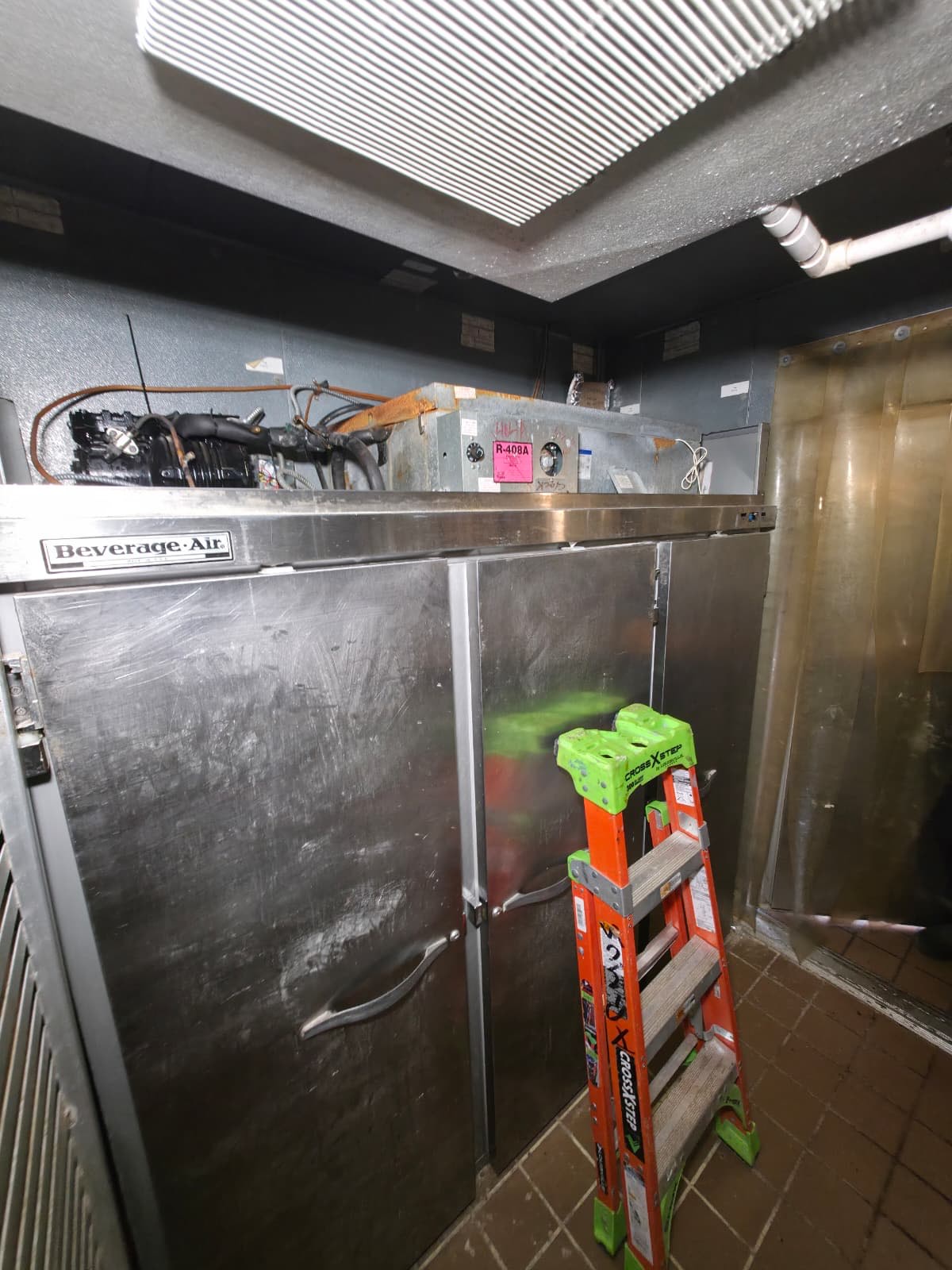
We handle everything commercial: True walk-in coolers, Beverage-Air glass-door merchandisers, Hoshizaki prep tables, you name it. If it’s keeping food cold for a restaurant or market out here near the South Coast of Boston, we’ll get to it.
The Tech Side: What Actually Goes Wrong in Your Walk-In Cooler
For more on AIM Act phase-down, see EPA SNAP-listed refrigerants.
When people call us, they usually just say, “It ain’t cooling.” That tells me nothing. To fix this right and not waste your time or money, I need to know what the actual failure point is. It could be anything from a simple refrigerant leak to a major component failure.
We check the big players first: Are we seeing high head pressure on the condenser side? Is the evaporator coil iced up because the defrost cycle isn’t kicking in right? Sometimes it’s as simple as a dirty condenser fan, which just chokes out the whole unit. Other times, and this is more serious, the compressor itself has burned out or the expansion valve has failed.
I won’t send you away until we diagnose it correctly. We use our knowledge of refrigerant pressure readings, capillary tube specs, and proper defrost cycle timing to narrow it down fast. You gotta know what’s wrong before you can fix it, simple as that.
Emergency Response Across the Greater Boston Area
For more on Massachusetts compliance, see EPA Section 608 refrigerant rules.
Our service area covers a lot of ground—from downtown Boston right out toward Quincy, maybe even over toward Cambridge if we’re running late from Fall River. Being local isn’t just about knowing where to find you; it’s about logistics and reliability.
If you’re operating in a high-traffic spot near the waterfront or deep in an older part of Boston, you can count on us for emergency response. When your cooler is down, time is money flowing out the door with every minute. That’s why we keep our crew ready to roll.
We’re licensed and insured because this isn’t a hobby; it’s keeping local businesses open. We treat your equipment like it’s ours. If you need service on a Manitowoc unit in the North End, or a walk-in freezer down near the waterfront docks, we know how to get there quickly.
When Repair Isn’t the Answer: Making Tough Calls
This is where I have to be straight with you. Sometimes, when a compressor is 18 years old and it fails, swapping just that part isn’t going to cut it. The motor mounts might be shot, or the electrical controls could be fighting us every step of the way.
I’ve seen brand-new units get bogged down by outdated infrastructure around them. If we spend a day wrestling with an old unit—replacing parts only to find another issue down the line—it’s often cheaper and faster for you to replace the whole box. We’ll walk you through that calculation. It’s not about selling you new stuff; it’s about making sure your operation gets back online with minimum downtime.
We assess everything: age of components, efficiency of the unit versus current food storage needs, and the cost-benefit of a full swap versus major overhauls.
Local Callout Proof Points
I remember last month at a seafood spot down in Boston’s South End. The glass-door merchandiser for their fresh catches wasn’t pulling enough cold air, and they were worried sick about the inventory sitting out on display all afternoon. We got there, checked the condenser coil—totally choked with salt residue from their prep work—cleaned it down thoroughly, bled off some old refrigerant lines we found weeping near the bottom, and had that unit humming again in under two hours.
Another time, I was out servicing a couple of reach-in units for a market over toward Dorchester. One tech thought it was the evaporator coil, but after checking the line voltage drop on the suction side—a quick test you wouldn’t think about—it turned out to be a simple issue with an improperly seated service valve. These small things derail big kitchens.
These aren’t just addresses on a map for us; they’re places where people rely on their coolers every single day. We know the rhythm of food service around here.
Beyond the Walk-In: Other Commercial Cooling Needs
While you came looking for walk-in cooler repair in Boston, I want to make sure you know we handle everything related to keeping your operation running cool. Ice machines are a huge part of any kitchen setup—whether it’s a big Manitowoc unit or just a smaller backup. We service those too.
And don’t forget the prep tables and specialized cold storage like beverage coolers. Whether you need us to diagnose why your Traulsen merchandiser isn’t holding temperature during peak hours, or if you suspect an issue with the primary refrigerant circuit on a walk-in freezer, give us a call. We cover the full spectrum of commercial cooling.
We’re EPA 608 certified because we handle refrigerants correctly every time. That’s non-negotiable when working in any commercial kitchen here. We’re ready for whatever failure you run into, day or night.
Diagnosing the Problem: What’s Actually Going Wrong
You call us because your walk-in cooler isn’t holding temperature. That’s what you hear. But I need to know what *you* hear, too. Sometimes it’s a faint humming noise coming from the condenser unit near the back loading dock. Other times, it’s just the lights flashing red on the controller panel.
Don’t assume it’s the compressor just because the unit is older than 12 years. A lot of issues are simpler—a tripped breaker in the electrical room, a blocked condenser coil from dust buildup near your kitchen prep table, or even just the refrigerant charge dropping due to a failing service valve. We check all that stuff before we start swapping major components.
For example, when I was out working on a True walk-in freezer down in South Boston last week, the main issue wasn’t mechanical at all; it was the condensate drain line backing up. The evaporator coil was getting waterlogged and couldn’t pull enough heat exchange to keep things cold. It’s those small details—the easy fixes that cost way less than a full compressor swap.
Keep It Running: Preventive Maintenance for Boston Kitchens
Look, I don’t want you calling us when it breaks down next month because you were too busy running the line at your restaurant to change a filter. Proactive care keeps you open. We recommend a full tune-up once or twice a year, especially before the summer rush hits up the North End restaurants.
What we do is pretty straightforward: We clean every coil—the condenser and the evaporator—so they can shed heat properly. We check refrigerant pressures across the system, looking for anything that suggests a slow leak in a capillary tube or expansion valve. We test the defrost cycle timing on your walk-in cooler to make sure it’s kicking off when it should.
If you want to be really smart about it, keep an eye on the door gaskets. If they’re cracked or warped, cold air is leaking out constantly, and your compressor will run overtime just trying to compensate for a draft. A quick inspection of those seals can save you hundreds in wasted electricity before we even touch a wrench.
The Brands We See Every Day: True, Beverage-Air, Hoshizaki
We work on everything out there—the big boys like Manitowoc and the reliable names like Continental. But if I’m being honest about what keeps my phone ringing in Boston proper, it’s mostly three brands popping up near Chinatown or around the Back Bay area: True, Beverage-Air, and Hoshizaki.
True units are rock solid when they’re running right, but their older compressors can be temperamental. Beverage-Air is common in those smaller deli setups—the glass-door merchandisers especially. And Hoshizaki walk-in freezers? They’ve been doing the job for decades. When you call us with a specific brand, it helps me pull up what I know about that model’s usual weak points.
Knowing the equipment brands means we don’t waste time guessing. If your unit is a 2010 Beverage-Air reach-in and the evaporator fan motor sounds rough, I know exactly where to start troubleshooting before I even see it. That kind of direct knowledge—that’s what keeps those Boston kitchens running through holiday rushes.
Ready to get walk in cooler repair in Boston, MA?
Call 508-521-9477 Schedule NowLooking for the broader picture? See our commercial refrigeration repair services across MA and RI — we cover walk-ins, ice machines, freezers, and restaurant refrigeration for Boston and the surrounding region.
Worth knowing if you run rooms in both states, because the structure is genuinely different. Rhode Island writes its code as 216-RICR-50-10-1 and inspects centrally through the Rhode Island Department of Health, not through a city board. A Providence kitchen answers to a statewide desk while your Boston kitchen answers to ISD, on the identical 41 degree number. We hold licensing on both sides of that line, and our service areas page lays out the coverage.
Pricing a new walk-in for your Boston location? See our walk-in freezer cost & repair guide — sizing, install cost, maintenance, and what restaurants actually pay.
- South Shore Walk-In Cooler and Freezer Repair
- Ice Machine Repair in Boston, MA
- Reach-In Cooler Repair
- Restaurant Refrigeration in Boston, MA
- commercial refrigeration repair in Greater Boston
Frequently Asked Questions
Can you repair a walk-in cooler in a North End or Chinatown basement where nothing fits down the stairs?
Yes, that is most of our Boston work. Compact basement boxes usually have the condensing unit remote on the roof or in an alley, so the parts that fail most, fan motors, contactors, expansion valves and gaskets, all come down the stairs easily. When a compressor has to be replaced we size the replacement to fit the space and the line set that is already there instead of proposing a new box.
Do you come out at night? We cannot get a truck near the restaurant during the day.?
We do. Downtown loading is nearly impossible during service, so most Boston repairs run after close or before the morning delivery window. Tell us the building’s after-hours access rules when you call and we plan the visit around them, including where the truck can legally stand.
Our condenser sits on a roof near the harbor. Why does it corrode so fast?
Salt air. Condensers in the Seaport and along the waterfront lose fin material and coil coating years earlier than inland units, and a corroded coil cannot reject heat, which drives head pressure and summer power bills up. Coil cleaning twice a year and a coated replacement coil when the time comes are the fixes; moving the unit is rarely practical on a Boston roof.
What does Boston Inspectional Services expect from my walk-in?
Cold-holding at 41 degrees F or below under 105 CMR 590, a readable thermometer and product that is actually at temperature. ISD inspectors check the food, not the dial, so a box with a weak evaporator fan can fail an inspection even with the compressor running. We leave a written temperature reading on the ticket you can keep with your inspection records.
Do you cover Cambridge, Somerville, Quincy and the North Shore from the same dispatch?
Yes. Boston dispatch covers Cambridge, Somerville, Brookline, Chelsea, Everett, Revere and Quincy, and runs up Route 1 and Route 128 to Lynn, Salem, Peabody and the rest of the North Shore. Drive time is longer to the North Shore, so we give you a realistic window rather than a promise we cannot keep.
Kitchens up Route 1 and Route 128 in Lynn, Salem, Peabody and the rest of the North Shore have their own page with realistic drive times from New Bedford: commercial refrigeration repair on the North Shore.