Sandwich is the oldest town on Cape Cod, and a lot of its commercial kitchens run inside buildings that predate mechanical refrigeration by a century or two. In twenty years of this trade I’ve worked on walk-in coolers in Sandwich inns and tavern kitchens where the box was assembled panel by panel through a doorway a modern pallet won’t clear, the evaporator hangs in a cellar with a ceiling cut for barrels, and the condensing unit sits in a shed fifty feet away because there was nowhere else to put it. A walk-in retrofitted into a structure like that fails differently than one in a strip-mall kitchen — and it has to be repaired differently, too.
The other thing about Sandwich: you’re the first town over the Sagamore Bridge. When your cooler quits on a Saturday with day-trippers coming off the Cape Cod Canal and the glass-museum crowd hunting lunch along Route 6A, geography finally works in your favor. I dispatch out of New Bedford, and Sandwich is the fastest Cape town for me to reach — Route 25 to the Sagamore and I’m at your door in roughly 45 to 55 minutes, while mid-Cape outfits are still fighting Hyannis traffic.
24/7 Emergency Walk-In Cooler Repair in Sandwich
A down walk-in is a countdown. A tight, well-gasketed box will coast for two to four hours if you keep the door shut; a leaky one in a hot August kitchen might give you ninety minutes before product crosses 41°F and you’re staring at a disposal decision. For a tavern kitchen holding a weekend’s worth of proteins, dairy, and prepped sauces, that’s easily $3,000 to $8,000 sitting on the line — usually more than the repair itself.
So I answer the phone nights and weekends, and I roll with the truck stocked: condenser and evaporator fan motors, defrost timers and termination thermostats, contactors, start components, TXVs, and recovery equipment. I run Armus Refrigeration out of New Bedford, and my goal on an emergency call in Sandwich is one trip — diagnose it, fix it, verify the box is pulling down, and leave you with numbers instead of guesses.
If I can’t get a part same-day — it happens with odd retrofitted equipment, and Sandwich has plenty of it — I’ll tell you straight and set up a bridge plan: temporary refrigeration, relocating product, or a controlled limp with strict door discipline. What I won’t do is gas-and-go a leaking system and call it fixed.
Finding the Real Fault, Not the Obvious One
Anyone can stand in front of a walk-in and say “it’s not cold.” Here’s what I actually measure before I touch a wrench:
- Superheat and subcooling. These two numbers tell me what the refrigerant is really doing. High superheat with low subcooling usually means a starved system — undercharged or restricted. Low superheat means the evaporator is flooding, which slugs liquid back at the compressor and kills it. I don’t add refrigerant until the numbers say the charge is the problem; most “needs a shot of gas” calls turn out to be airflow or a metering device.
- Compressor amp draw against nameplate RLA. A compressor pulling well over its rated load amps is telling you something — a dirty condenser, failing valves, or a motor on its way out. Trending amp draw catches a compressor a season before it dies, which matters when the replacement has to come down a set of two-hundred-year-old cellar stairs.
- Defrost cycle operation. Most cooler evaporators defrost off-cycle with air, but plenty of Sandwich boxes run cold enough to need electric defrost, and it has three classic failure modes: a mechanical timer that stopped advancing, a burned-out heater element, or a dead termination thermostat — so either the coil ices into a solid block or the heaters cook the box every cycle. An iced coil looks exactly like “low on charge” to anyone who doesn’t pull the panels.
- Condenser condition and airflow. More on this below — coil fouling is the most preventable killer I see on the Cape.
- Door gaskets, sweeps, hinges, and the box itself. Infiltration is a load your compressor pays for every hour it runs.
I’m certified under EPA Section 608, which federal law requires of anyone recovering or handling refrigerant. That matters more every year: older R-404A systems are getting expensive to feed, venting is illegal, and a chronic leaker now carries real regulatory and dollar consequences. If your system leaks, I find the leak and repair it properly — I don’t top it off quarterly forever.
Walk-Ins Retrofitted Into Historic Buildings: What Actually Breaks
This is Sandwich’s signature problem. The town dates to 1637, and along Route 6A and the village center there are inns, taverns, and B&B kitchens operating inside timber-frame structures that were never meant to hold a refrigerated box. The walk-in was shoehorned in decades ago, and the compromises made on installation day are what I get called about now:
- Remote condensing units on long line sets. No roof access, no alley — so the condensing unit ended up in a shed, a barn, or bolted to a back wall, sometimes sixty-plus feet of refrigerant line away. Long runs bring oil-return problems, charge sensitivity, and pressure drop the original installer never accounted for. Oil-starved, slugging compressors are the common ending.
- Undersized condensing units. When the biggest unit that fit through the bulkhead is the one that got installed, the system runs near its limit every July. It works — until one hot week plus a slightly dirty coil pushes head pressure over the edge.
- Low cellar ceilings starving the evaporator. A coil mounted inches under a beam recirculates its own discharge air. The coil ices, superheat goes haywire, and the “mystery” intermittent warm-up begins.
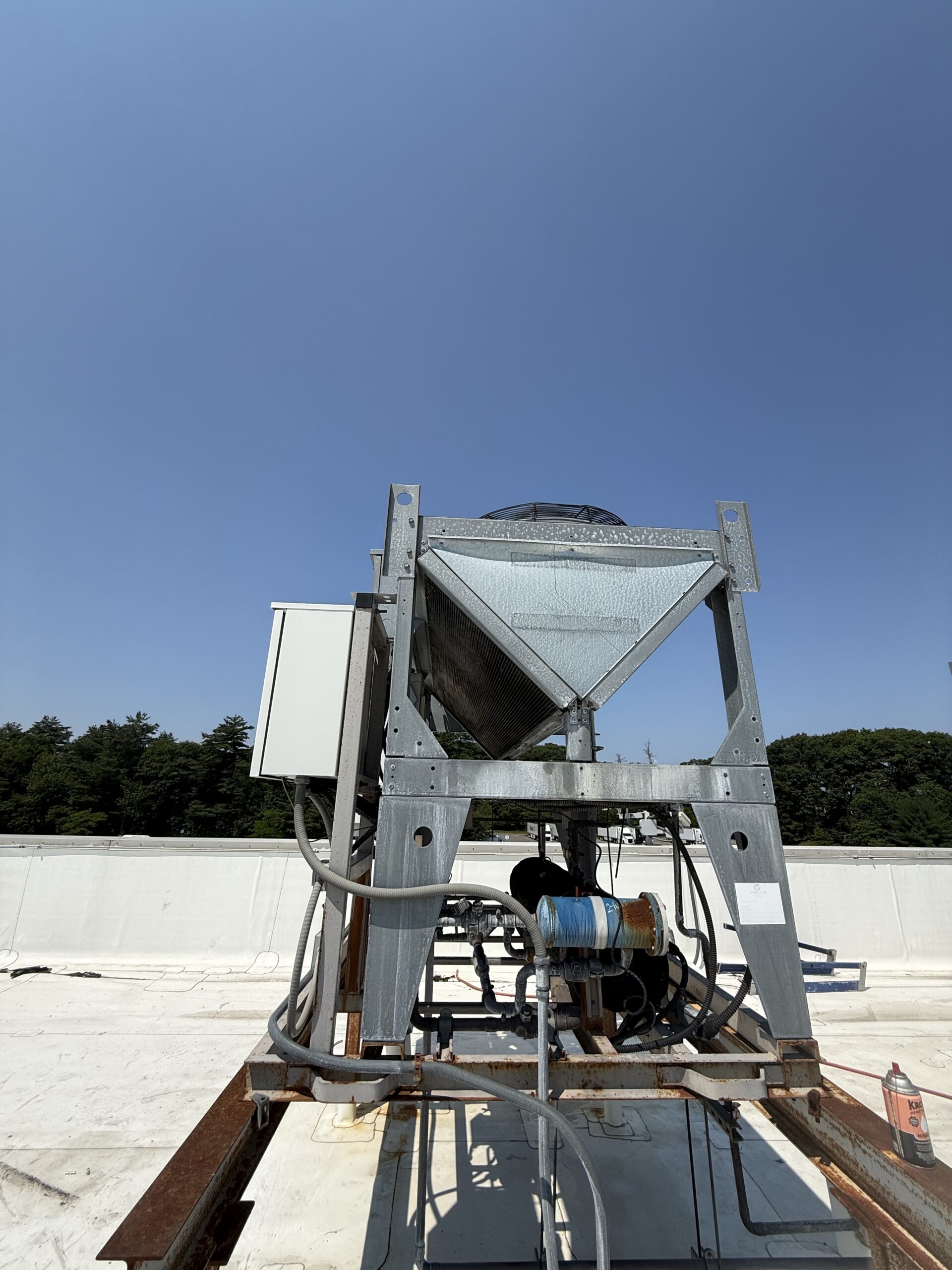
- Outdoor units eating salt air. Near the canal and the marsh, salt-laden air rots condenser fins years ahead of an inland unit. Fin corrosion quietly strangles heat rejection long before the coil looks dramatic.
- Panel and door damage in tight service paths. When every keg, case, and cart in the building squeezes past the walk-in door twice a day, gaskets, hinges, and panel skins take a beating no spec sheet planned for.
I size repairs to the building, not the catalog. In a structure this old, the right answer sometimes isn’t the textbook one — it’s the one that delivers reliable refrigeration without demolishing a staircase to get there.
Massachusetts Inspections: 105 CMR 590 and the 41°F Line
In Massachusetts, your local board of health inspects food establishments under 105 CMR 590, which adopts the FDA Food Code. The number that matters for your walk-in is 41°F cold holding — and that means product temperature when the inspector probes it, not whatever the dial on the door claims.
Two things bite Sandwich operators. First, air temperature and product temperature aren’t the same: a box that recovers slowly after the lunch rush can read 40°F at the thermostat while the top shelf of chicken sits at 44°F. Second, a marginal cooler passes in April and fails in July, because the same compressor that kept up at 60°F ambient can’t reject heat at 88°F through a fouled condenser.
When I service a walk-in I verify pulldown and holding temperature at product level, and I leave written documentation of what was measured and what was done. If you’ve been written up for a temperature violation, that dated paper trail is exactly what you want in hand at reinspection.
Preventive Maintenance on Sandwich’s Shoulder-Season Rhythm
Sandwich doesn’t run on Hyannis’s calendar. Mid-Cape it’s a hard summer peak; here the glass museum, the heritage attractions, and the Route 6A day-trip trade stretch the season wide — busy spring weekends well before Memorial Day, and a fall run that keeps kitchens working deep into October. That changes when maintenance should happen:
- Early spring, not late spring. If your first big weekends land in April and May, the pre-season condenser cleaning, refrigerant-circuit check, and door survey need to happen in March — before your first warm stretch, not after your first failure.
- A mid-season condenser look. Condenser coil fouling raises head pressure, which raises compressor amp draw, which raises your electric bill while it cooks the motor windings — a 10°F climb in condensing temperature can cost you 10 to 15 percent in capacity and efficiency. Pollen in May, cottonwood in June, kitchen grease all year. Fifteen minutes with coil cleaner beats a $4,000 compressor.
- Gasket economics, done honestly. A walk-in door gasket runs a couple hundred dollars installed. A torn one pulls humid air around the clock: the evaporator ices, defrost falls behind, run time climbs, and the compressor works nights. That gasket pays for itself in months on energy alone, never mind compressor life. Same math for door sweeps and self-closing hinges.
- Fall setback done right. If you close or scale back for winter, there’s a correct way to set back or shut down a walk-in — and a wrong way that greets you with a corroded, seized system in March.
Service Area and Honest Response Times From New Bedford
My dispatch base is New Bedford, MA — I won’t pretend I have a truck idling at the canal. But the map genuinely favors Sandwich: Route 25 over the Sagamore Bridge puts me in town in about 45 to 55 minutes in normal traffic. First over the bridge means the best response times on the Cape from my shop.
Where I’ll be straight with you: summer bridge traffic is real. If your call comes in at 4 PM on a July Friday, I’ll give you a real ETA, not a fantasy one. Most emergencies I’m hands-on-equipment the same day, and off-peak or off-season it’s usually right around an hour door to door.
I cover Sandwich village, East Sandwich, Forestdale, and the Route 130 corridor, plus the neighboring canal towns. Farther down-Cape, I still come — just with an honest clock attached.
The Day-Trip Lunch Rush: Sandwich’s Failure Window
Every town’s refrigeration fails at its own worst moment. In Sandwich it’s the day-trip lunch window. Your trade isn’t week-long resort stays — it’s cars coming over the Sagamore in the morning, the glass museum and the historic village before noon, and everybody hungry at once from 11:30 to 1:30. Canal-side spots take the sightseeing and bike-path crowd on top of that.
That compressed rush is brutal on a walk-in. The door swings constantly for two hours, humid air pours in, the evaporator loads up, and a marginal system that held fine at 10 AM reads 45°F by 1 PM. If your cooler creeps up during every service and claws back by mid-afternoon, that isn’t “normal for summer” — that’s a system with no reserve capacity left. It’s also the cheapest moment to fix it: before the day it doesn’t recover.
Call me at the creep stage and it’s a scheduled maintenance visit. Call me the day it quits and I’ll still come — but you’ll be running service out of coolers and ice while I work.