
Marion is not a restaurant town, and anyone who works this stretch of Buzzards Bay knows it. There is no strip of competing kitchens like you’d find along Route 6 in Fairhaven or downtown New Bedford. What Marion has instead is a working harbor and the institutions that ring it: clubhouse kitchens overlooking Sippican Harbor, a general store half the town moves through on a Saturday morning, a few cafés, and Tabor Academy — a boarding school whose dining operation feeds hundreds of students three meals a day, which makes it the largest single refrigeration load in town. Nearly every one of those kitchens depends on a walk-in cooler, and most of them are running exactly one.
That last part matters more than people think. A chain restaurant with a dead walk-in shifts product to the next location and files a claim. A café or a clubhouse kitchen in Marion has one box, one inventory, and no backup. When that cooler drifts past 41°F, the loss comes straight out of the owner’s pocket. I’ve spent twenty years fixing commercial refrigeration out of New Bedford, and Marion calls get answered fast for a simple reason: you’re twenty to twenty-five minutes from my shop up Route 6 or I-195. That’s close enough that “emergency” usually means I’m standing in your kitchen the same morning you call.
When a Walk-In Goes Down in Marion, Same-Morning Service Is Realistic
I’ll be straight about response times because too many outfits aren’t. My dispatch base is New Bedford, MA. Marion is one of the closest towns I serve — a clean run up Route 6, or I-195 to the Rochester side and down. Off-peak, that’s about twenty minutes. In summer traffic, twenty-five. So when a Marion café owner calls at 6:30 a.m. because the walk-in read 52°F when they opened, same-morning arrival isn’t a sales line. It’s just geography.
While you wait: keep the door shut. A loaded walk-in with a tight door holds temperature for hours on thermal mass alone. Don’t prop it open to “check” the product every ten minutes — every door swing dumps your cold air on the floor. Move nothing until we know whether this is a forty-minute fix or a compressor. Half the time in Marion it’s the forty-minute fix.
What I Actually Check Before Quoting You
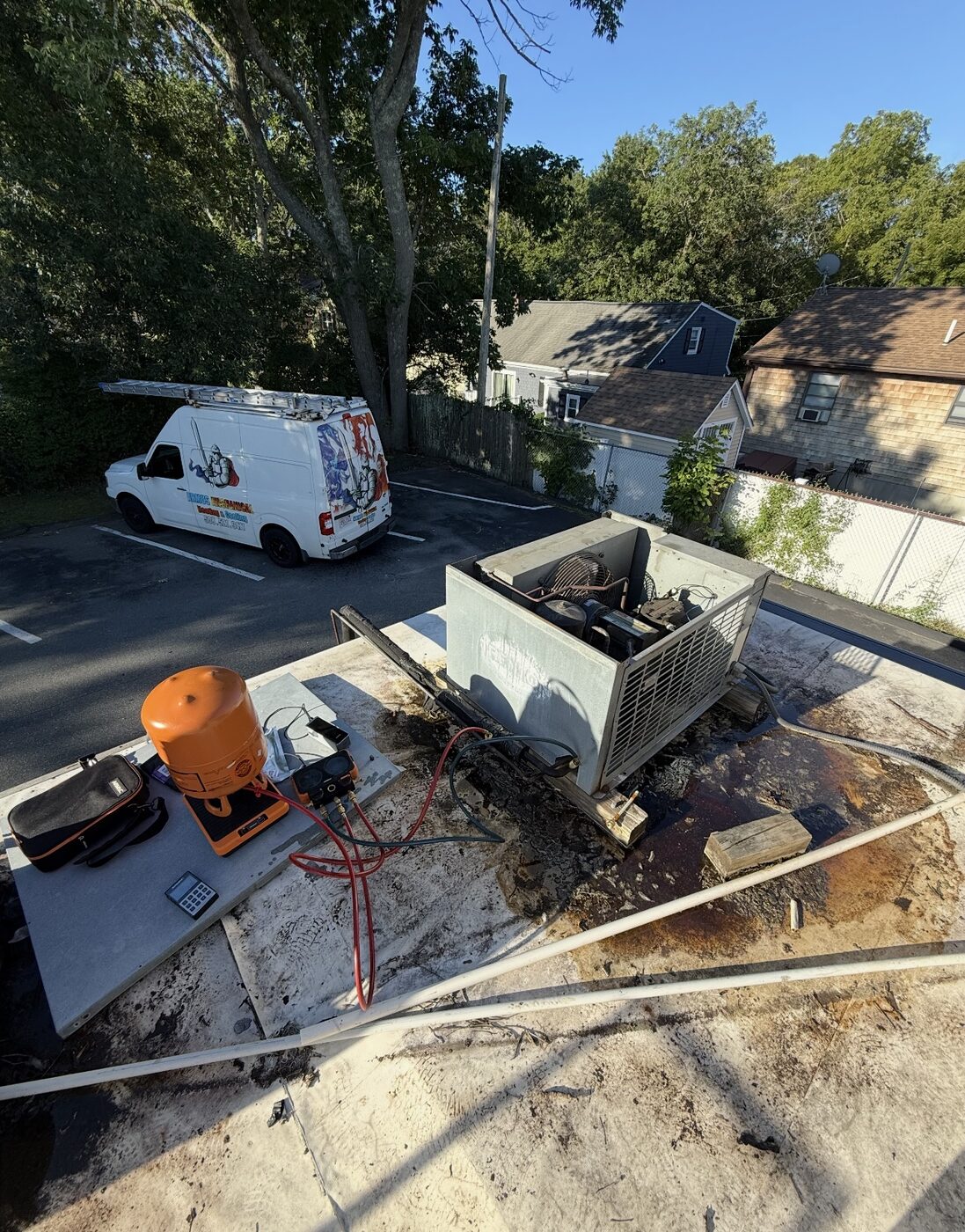
Guesswork is expensive; measurements are not. When I put gauges on your system, I’m reading superheat at the evaporator outlet and subcooling at the condenser. Those two numbers tell most of the story. High superheat with low subcooling means the system is starved — usually a refrigerant leak, and on harborside equipment in Marion, usually a corrosion pinhole. High subcooling with high head pressure points at a fouled or airflow-blocked condenser coil. Numbers in range with warm box temps? Now we’re looking at airflow, defrost, or door infiltration instead of the sealed system.
I also clamp the compressor and check amp draw against the rated load amps on the nameplate. A compressor pulling well over RLA is fighting something — dirty condenser, overcharge, failing valves — and it’s telling you it will die if nobody listens. Catching that on a Tuesday costs you a service call. Catching it in July costs you a compressor and a cooler full of product.
On refrigerant: I’m certified under EPA Section 608, which is the federal requirement for anyone opening a sealed system. If a tech “tops off” your walk-in every spring without finding and repairing the leak, that’s not maintenance — it’s a compliance problem and a slow bleed on your wallet. I find the leak, fix it, and document the repair.
Salt Air Off Sippican Harbor Eats Condensers Alive
This is the Marion-specific failure mode. Condensing units within reach of salt air corrode years faster than the same unit inland. The aluminum fins on the condenser coil pit and powder, the fin-to-tube bond degrades, and heat rejection falls off even when the coil looks “clean.” The system compensates with higher head pressure, higher amp draw, and shorter compressor life. I’ve pulled condensers off waterfront buildings around Buzzards Bay that were structurally ten years older than their nameplate date.
For harborside kitchens — clubhouses, anything with a condensing unit on a roof or pad facing the water — I do three things: rinse coils with fresh water on a schedule, not just when they look dirty; apply coil coatings on replacements; and when a unit is due, spec marine-duty coated coils up front. It’s a modest premium that roughly doubles coil life in this environment. Nobody selling equipment out of a catalog will tell you that. Someone who’s cut open corroded coils from this harbor will.
Clubhouses, a Boarding School, and Provisioning Coolers: What Marion Actually Runs
Marion’s refrigeration is institutional and seasonal in a way most towns aren’t. The clubhouse kitchens near Sippican Harbor run hard from Memorial Day to Columbus Day, then sit nearly idle all winter. That idle period is where spring failures are born: gaskets take a set, start components sit, and refrigerant migrates to the coldest point in the system. First hot weekend of the season, everything gets asked to sprint from a cold start — and that’s when the phone rings.
Then there’s the provisioning side. Boaters stocking up for a week on Buzzards Bay buy cold product — and the stores and dockside operations holding that inventory are running walk-ins hard through the exact months when ambient heat and door traffic peak. And Tabor Academy’s dining operation is a different animal entirely: school-year volume, institutional food-safety accountability, and zero tolerance for a cooler failure with hundreds of students to feed. Each of those operations fails differently, and I service all three types.
Marion Board of Health, 105 CMR 590, and the 41°F Line
In Massachusetts, your local board of health inspects food establishments under 105 CMR 590, which adopts the FDA Food Code. The number that matters for your walk-in is 41°F cold holding. Above that line, TCS foods are on a clock, and an inspector finding product at 45°F doesn’t care that “the cooler’s always run a little warm.”
In a town Marion’s size, the health agent knows every kitchen personally. That cuts both ways: there’s nowhere to hide a marginal cooler, but a documented maintenance and temperature-log history goes a long way when a unit does act up. I set clients up with a simple log discipline and calibrated thermometers, and I leave written findings after every visit. When the inspector asks what happened and what you did about it, you hand them paper.
Preventive Maintenance on Marion’s Seasonal Clock
Maintenance here should follow the town’s rhythm, not a generic quarterly calendar. Spring startup — before Memorial Day, not after — means coil cleaning, a refrigerant-charge check via superheat and subcooling, condensate line clearing, and running the defrost cycle manually to confirm it completes.
Defrost deserves its own paragraph because it’s the most misdiagnosed failure I see. A walk-in evaporator ices up for one of a few reasons: a failed defrost timer that never initiates, a burned-out defrost heater, a stuck termination thermostat, or warm moist air pouring past a bad door gasket faster than the defrost cycle can keep up. The symptom is always the same — box temp creeping up, coil buried in ice, fans straining — but the fixes range from a $40 part to a gasket to a controls repair. Melting the ice with a heat gun and walking away, which I’ve seen other outfits do, just resets the countdown.
And the gasket economics, because small operators feel this: a door gasket runs a couple hundred dollars installed. A torn gasket on a busy provisioning cooler pulls humid harbor air into the box all day, ices the coil, stretches compressor runtime, and inflates the electric bill every single month. It is the cheapest repair on the whole machine and the one most owners defer longest. Do the dollar-bill test — close the door on a bill and pull; if it slides out easily, the gasket’s done paying for itself in the wrong direction.
Service Area and Honest Response Times From New Bedford
I run out of New Bedford and cover the South Coast on both sides of the state line. Marion sits in my closest ring alongside Mattapoisett, Rochester, and Wareham — twenty to twenty-five minutes, routinely same-morning for down coolers and same-day for everything else. Emergency service is 24/7, and after-hours calls in Marion get the same drive time; Route 6 at 2 a.m. is empty.
What I won’t do is quote you “one-hour response, guaranteed” like the national dispatch services that then subcontract your call to whoever answers. You call 508-521-9477, you get me or my dispatcher, and the ETA you’re given is a real one based on where the truck actually is.
Why Small-Town Kitchens Get My Best Work
Twenty years in, I’ll tell you a truth about this trade: small accounts keep techs honest. A chain kitchen approves whatever’s on the estimate. A Marion café owner or a club kitchen manager looks you in the eye and asks whether the compressor really needs replacing or whether it’s a $180 start relay — and in a town this size, the answer follows you. My business in Marion runs on that. I repair what’s repairable, I tell you plainly when a fifteen-year-old box with a corroded coil is a money pit, and I show you the readings either way. Superheat, subcooling, amp draw, temperatures — on paper, in your hand, before you approve a dollar.